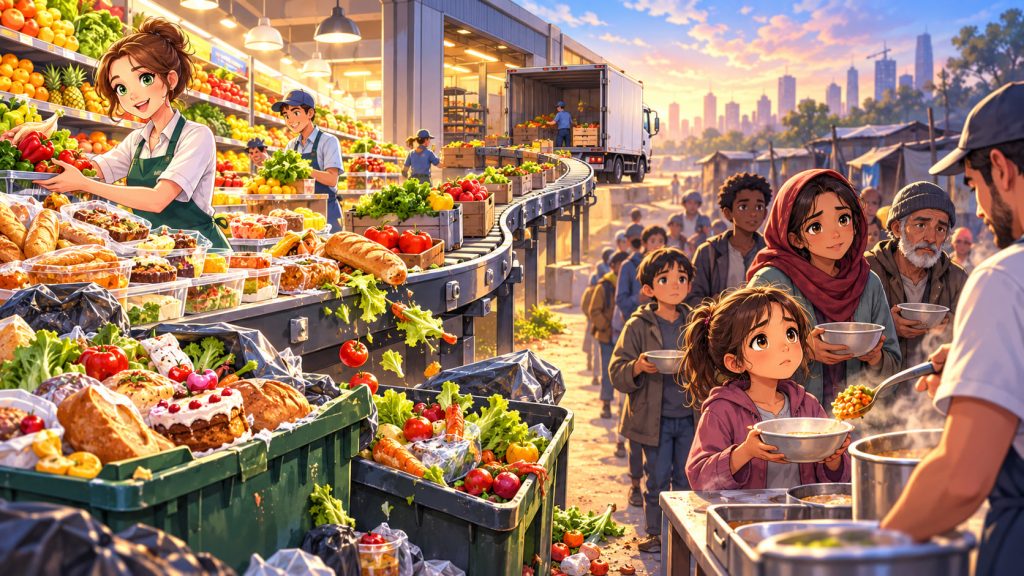
The modern food system can produce extraordinary abundance. Supermarkets offer food from multiple continents, farms achieve yields unimaginable a century ago, and global agriculture produces enough calories to feed billions of people.
Yet hundreds of millions still experience chronic hunger, while enormous quantities of edible food are discarded, left to rot, or deliberately destroyed.
This apparent contradiction is one of the clearest signs that hunger is not simply a problem of producing too little food. It is also a problem of access, poverty, distribution, infrastructure, commercial incentives, conflict, and waste.
The World Produces Food, but Not Everyone Can Buy It
Around 670 million people were estimated to have experienced hunger in 2024. Many more regularly struggle to obtain nutritious and reliable meals.
The central issue is often food insecurity: a lack of consistent physical or economic access to sufficient, safe, and nutritious food.
A country can have full supermarkets while part of its population goes hungry.
Food may physically exist nearby, but households without adequate income cannot purchase it. This is why famine and hunger can occur even when food remains available in markets.
Food abundance and food access are not the same thing.
Why So Much Food Is Lost Before It Reaches Consumers
A large share of food disappears long before anyone has the opportunity to eat it.
This is known as food loss. It occurs during farming, harvesting, storage, processing, and transportation.
Fruit may rot because refrigerated storage is unavailable. Grain can be damaged by moisture, fungi, insects, or rodents. Vegetables can spoil during long journeys on poor roads.
In some lower-income regions, inadequate warehouses, cold storage, electricity, transportation, and packaging contribute significantly to these losses.
Reducing food loss therefore requires much more than encouraging people to waste less at home. It requires investment in the entire supply chain.
Food Waste Happens After Food Reaches the Market
Food waste usually describes food discarded by retailers, restaurants, institutions, and households.
Globally, more than a billion tonnes of food were estimated to have been wasted at the retail, food-service, and household level in a recent year.
Households account for a particularly large share.
People buy more than they can consume, misunderstand date labels, cook oversized portions, forget food in refrigerators, or reject products that no longer look fresh despite remaining edible.
Restaurants may prepare extra food so customers never see empty displays. Hotels and buffets often prioritize constant abundance because an almost empty serving area can appear unattractive.
The result is a system where visual abundance itself can create waste.
Why Supermarkets Sometimes Throw Away Edible Food
Retailers operate under strict commercial and food-safety constraints.
Fresh bread, fruit, vegetables, dairy products, prepared meals, and meat have limited selling windows. Customers often select the freshest-looking items, leaving older products behind.
Supermarkets also try to maintain fully stocked shelves because empty spaces can reduce sales.
Products may therefore be discarded because of damaged packaging, approaching expiration dates, cosmetic imperfections, or declining demand.
Some businesses donate surplus food, discount products near their use-by dates, or send organic material to animal feed and energy production.
But redistribution is not always simple.
Food must remain safe, refrigerated when necessary, collected quickly, sorted, transported, and delivered to organizations capable of using it.
Why Farmers Sometimes Destroy Perfectly Good Crops
One of the most disturbing images in modern agriculture is a farmer plowing edible crops back into the ground.
However, the explanation is often economic rather than purely wasteful.
Agriculture is vulnerable to overproduction. If unusually favorable weather produces a massive harvest, the market price of a crop can collapse.
Imagine that harvesting, packing, and transporting a field of vegetables costs more than the farmer can earn by selling them.
Leaving the crop unharvested can become the least financially damaging option.
Similar situations can occur when restaurants suddenly reduce orders, export markets close, processing facilities stop accepting deliveries, or consumer preferences change.
This illustrates a form of market failure in which socially valuable food may have too little commercial value to justify bringing it to consumers.
Why Surplus Food Cannot Simply Be Sent Everywhere Hunger Exists
It seems logical to take unwanted food from wealthy regions and transport it to hungry populations.
Sometimes this works. Food banks, humanitarian organizations, and redistribution networks recover enormous quantities of usable food.
But long-distance redistribution has limits.
Fresh strawberries discarded tonight in one country cannot easily be delivered to a drought-affected village thousands of kilometers away before spoiling.
Transportation costs money. Refrigeration requires infrastructure. Border procedures take time. Some communities need staple grains, cooking oil, or protein rather than pastries and prepared meals nearing expiration.
Permanent hunger therefore cannot be solved simply by shipping leftovers around the planet.
Poverty Is One of the Strongest Drivers of Hunger
Hunger is closely connected with economic access.
A family does not need to live where food is scarce to experience hunger. It only needs to be unable to afford what is available.
Inflation can make this problem significantly worse.
When food prices rise faster than household income, families may reduce meal sizes, purchase cheaper and less nutritious foods, or skip meals.
This is why economic shocks can rapidly increase hunger even without a major decline in national food production.
War Can Turn Food Availability Into Famine
Conflict can destroy an otherwise functioning food system.
Farmers may abandon fields. Roads become unsafe. Fuel becomes scarce. Ports close. Markets disappear. Irrigation systems and warehouses may be damaged.
Humanitarian agencies describe severe hunger emergencies as a combination of food shortages, collapsing incomes, restricted transportation, displacement, and limited humanitarian access.
Modern famines are therefore rarely explained by agriculture alone.
Food can exist somewhere in a country while becoming effectively unreachable to the people who need it most.
Climate Stress Makes the System More Fragile
Drought, floods, heat waves, wildfires, and changing rainfall patterns can reduce agricultural production and increase price volatility.
A single bad harvest does not usually create global food scarcity, but repeated disruptions can increase vulnerability.
Poor households suffer first because they spend a larger share of their income on food.
Countries highly dependent on food imports can also be exposed to global price shocks.
A resilient food system therefore requires diverse production, reliable storage, efficient transportation, responsible water management, and functioning trade networks.
The Environmental Cost of Throwing Food Away
Food waste is not only a social issue.
Producing food requires land, water, fertilizer, labor, machinery, electricity, packaging, and transportation.
When food is thrown away, much of the energy and resources used to produce it are wasted as well.
Food decomposing in landfills can also generate methane, a powerful greenhouse gas.
Reducing waste therefore improves resource efficiency: producing more useful nutrition from the same amount of land, water, energy, and labor.
What Experts Emphasize About Global Hunger
Food-policy specialists generally emphasize that solving hunger requires addressing access as well as production.
Increasing agricultural output can be important, particularly in rapidly growing or climate-stressed regions. But production alone cannot eliminate hunger if people lack income, markets, transportation, political stability, or social protection.
Effective strategies include better storage infrastructure, stronger transport systems, food assistance, school meal programs, improved agricultural productivity, surplus redistribution, and policies that reduce unnecessary waste.
The greatest opportunity is not one single technological solution.
It is building a system in which food is produced efficiently, reaches markets safely, remains affordable, and is used rather than discarded.
A System Designed Around Demand, Not Human Need
Commercial food systems primarily respond to purchasing power.
A supermarket stocks products because customers are expected to buy them. A farmer grows crops because there is an expected market. A manufacturer produces food when it expects profitable demand.
Human biological need does not automatically create economic demand.
A wealthy neighborhood can support dozens of restaurants while a poor community elsewhere struggles to secure basic meals.
This mismatch explains much of the apparent absurdity.
The world can simultaneously contain excess consumption, enormous food waste, and severe hunger because markets distribute products mainly according to economic demand rather than according to nutritional need.
P.S. Only together can we emerge from the global crisis we ourselves created. It is not too late to change things; by using social media for constructive purposes, everyone can contribute significantly to building a free and happy world—one we can be proud to leave to our children.
Interesting Facts
- More than one billion tonnes of food can be wasted globally in a single year at household, restaurant, and retail levels.
- Households are responsible for a large proportion of consumer-level food waste.
- Significant quantities of agricultural production are also lost before reaching stores or consumers.
- Fruits and vegetables are especially vulnerable to losses because they spoil quickly and can be damaged easily.
- Refrigerated transport and cold storage can dramatically extend the usable life of fresh food.
- Food discarded in landfills can release methane during decomposition.
- Cosmetic standards can contribute to rejection of edible fruits and vegetables because of unusual size, shape, or appearance.
- Donating surplus food can help local communities, but redistribution requires storage, transportation, labor, and food-safety controls.
Glossary
- Food Insecurity — Uncertain or insufficient access to adequate, safe, and nutritious food.
- Food Loss — Food that disappears or becomes unusable during production, harvesting, storage, processing, or transportation.
- Food Waste — Edible or potentially edible food discarded mainly by retailers, restaurants, institutions, or households.
- Supply Chain — The network through which food moves from farms and producers to processors, distributors, retailers, and consumers.
- Overproduction — Production of more goods or food than the market can economically absorb.
- Market Failure — A situation in which normal market incentives do not produce an efficient or socially desirable outcome.
- Economic Access — A person’s or household’s financial ability to obtain necessary goods such as food.
- Resource Efficiency — Using land, water, energy, materials, and labor in ways that produce the greatest useful benefit with minimal waste.