Healthy land is the foundation of agriculture, forests, freshwater systems, biodiversity, and much of the global economy. Yet vast areas of productive soil are being damaged by erosion, deforestation, overgrazing, intensive farming, mining, urban expansion, salinization, and climate extremes.
Today, restoring damaged landscapes is no longer viewed simply as a conservation project. It has become a global economic, food-security, and climate challenge.
Estimates suggest that up to about 40% of the world’s land is degraded to some degree, affecting billions of people directly or indirectly. As populations grow and climate pressures intensify, societies cannot rely indefinitely on converting new natural ecosystems into farmland.
Increasingly, the alternative is clear: repair the land we already use.
What Does Land Degradation Actually Mean?
Land degradation occurs when soil, vegetation, water systems, or ecological functions lose their ability to support productive ecosystems and human activities.
A degraded landscape does not necessarily look like a desert. A field can remain green while its soil gradually loses nutrients, organic matter, water-holding capacity, and biological diversity.
Degradation can result from repeated intensive cultivation, excessive livestock grazing, removal of forests, poor irrigation practices, industrial pollution, or uncontrolled development.
Once fertile land deteriorates, farmers often require more fertilizer, irrigation, and other inputs simply to maintain the same level of production.
Soil Is Being Lost Faster Than It Can Naturally Recover
One of the greatest threats is erosion.
Rainfall and wind naturally move soil, but removing vegetation and repeatedly disturbing the ground can dramatically accelerate the process. The fertile upper layer of soil is particularly important because it contains nutrients, organic matter, microorganisms, and plant roots.
Forming substantial new topsoil naturally can take centuries.
When productive soil is washed into rivers or blown away by wind, replacing its ecological functions is therefore extremely difficult.
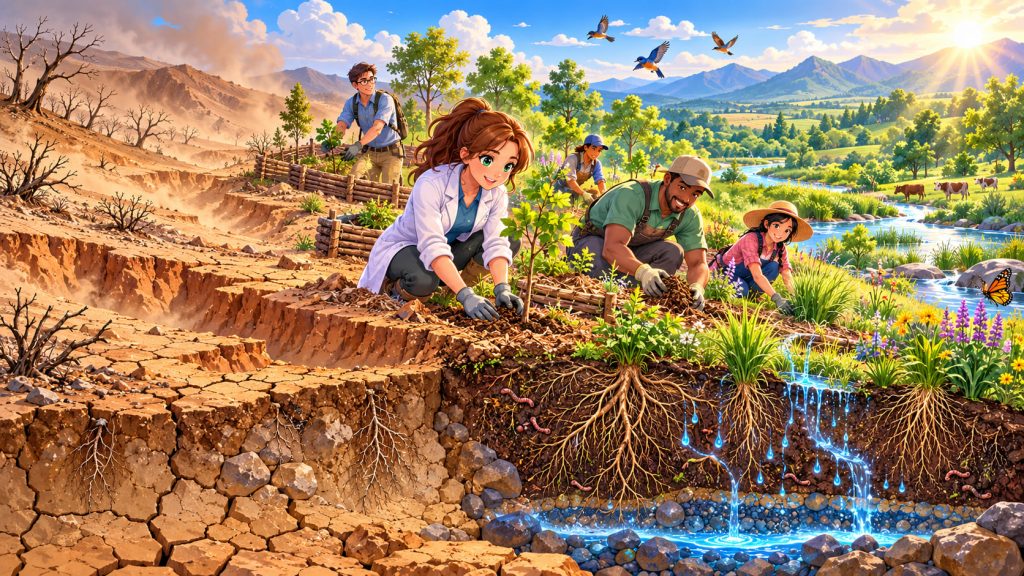
Restoration techniques such as cover crops, terraces, windbreaks, reduced tillage, and permanent vegetation can slow erosion and gradually rebuild soil structure.
Degraded Land Threatens Global Food Security
Agriculture depends on functioning soil.
Healthy soil stores water, cycles nutrients, supports microorganisms, anchors roots, and provides plants with the conditions required for growth.
When soils degrade, crop yields can become less reliable.
This matters because agriculture must support a large global population while facing increasingly frequent droughts, floods, heat waves, and water shortages.
Restoring degraded agricultural land can improve soil organic carbon, increase water retention, reduce erosion, and support more stable crop production.
Soil scientist and World Food Prize laureate Rattan Lal has long emphasized the importance of rebuilding soil organic carbon for soil health, agricultural productivity, climate resilience, and food security.
Desertification Is Not Simply the Expansion of Deserts
Desertification is land degradation occurring in dryland regions.
It can result from interactions between climatic conditions and human activities such as deforestation, excessive cultivation, poor water management, and overgrazing.
The process can reduce vegetation cover and soil fertility while increasing erosion.
Restoration does not necessarily mean planting dense forests everywhere. In naturally dry environments, inappropriate tree planting can create new ecological problems.
The goal is to restore vegetation and land functions suited to the local climate, whether that means grasslands, shrublands, savannas, wetlands, or forests.
Restored Land Can Store More Carbon
Land restoration also matters for climate policy.
Plants absorb carbon dioxide during photosynthesis, while soils can store large quantities of carbon in organic matter.
Rebuilding forests, grasslands, wetlands, and agricultural soils can therefore increase carbon storage.
However, restoration is not a substitute for reducing fossil-fuel emissions.
Protecting an intact ecosystem is generally more effective than destroying it and attempting to recreate it later.
Restoration ecologists therefore emphasize both conservation and repair rather than treating damaged landscapes as easily replaceable.
Healthy Landscapes Manage Water Better
Land condition strongly affects the movement of water.
Compacted or bare soil often absorbs rainfall poorly. Heavy rain then runs across the surface, increasing erosion and potentially contributing to flooding.
Vegetated landscapes usually intercept rainfall, stabilize soil, and allow more water to infiltrate underground.
A watershed with healthy forests, grasslands, wetlands, and soils can regulate water flows more effectively than a severely degraded landscape.
Restoring vegetation upstream can therefore benefit farms, reservoirs, rivers, towns, and cities downstream.
Restoration Can Bring Ecosystems Back to Life
Land degradation removes more than soil fertility.
It can simplify entire ecosystems.
When native vegetation disappears, insects lose food and habitat. Birds lose nesting areas. Pollinators decline. Soil organisms disappear, and food webs become less complex.
Healthy landscapes provide numerous ecosystem services, including pollination, water purification, carbon storage, flood regulation, soil formation, and temperature regulation.
Restoration can reconnect fragmented habitats and give wildlife opportunities to return.
In some places, assisted natural regeneration is particularly effective. Instead of planting every tree manually, people protect surviving vegetation, control grazing or fire, and allow native plants to recover naturally.
Large-Scale Restoration Has Already Worked
Some restoration projects demonstrate how dramatically damaged landscapes can change.
China’s Loess Plateau was heavily affected by centuries of erosion. Large restoration programs introduced terracing, vegetation recovery, controlled grazing, and improved agricultural practices. Parts of the region experienced major improvements in vegetation, soil conservation, and agricultural productivity.
In Niger, farmers have encouraged naturally regenerating trees on agricultural land rather than removing every woody plant. This approach has restored tree cover across large areas while supporting farming communities.
Such projects demonstrate that land restoration does not always require recreating untouched wilderness.
It can combine ecological recovery with agriculture and local livelihoods.
Farming Practices Are Part of the Solution
Much degraded land remains actively used for agriculture.
For this reason, restoration increasingly overlaps with regenerative agriculture: farming approaches designed to improve soil and ecosystem functions while maintaining food production.
Practices can include crop rotation, cover cropping, reduced soil disturbance, agroforestry, managed grazing, compost use, and maintaining living roots for longer periods of the year.
Not every method works everywhere.
Climate, soil type, crop choice, economics, and local farming traditions determine which approaches are practical.
Successful restoration therefore depends on adapting techniques to individual landscapes rather than applying one universal formula.
Restoration Is Also an Economic Investment
Degraded land creates costs that extend beyond agriculture.
Governments may spend more on flood control, water treatment, disaster recovery, irrigation, fertilizer subsidies, and infrastructure repairs.
Farmers can lose productivity. Reservoirs can fill with sediment. Tourism can decline when ecosystems deteriorate.
Restoration can reverse some of these losses.
The economic benefits may take years to appear, but healthier landscapes can provide productive value for decades.
Restoring land is increasingly being treated as infrastructure investment rather than simply environmental spending.
Why the Challenge Is Becoming More Urgent
Climate change increases the pressure on already weakened landscapes.
Longer droughts can damage vegetation. Extreme rainfall can accelerate erosion. Wildfires can remove protective plant cover, while rising temperatures increase evaporation.
A healthy ecosystem is not immune to these stresses, but it is often more resilient.
Degraded landscapes begin with fewer reserves: less vegetation, poorer soil structure, reduced biodiversity, and lower water-storage capacity.
This creates a dangerous cycle in which degradation increases vulnerability, and climate extremes then accelerate further degradation.
Breaking that cycle is why land restoration is becoming one of the defining environmental tasks of the coming decades.
Interesting Facts
- Up to roughly 40% of global land is estimated to experience some form of degradation.
- A large proportion of terrestrial carbon is stored below ground in soils rather than in visible vegetation.
- Healthy soils can absorb and retain substantially more rainfall than severely compacted or eroded soils.
- Natural regeneration can sometimes restore vegetation more cheaply than large-scale tree planting.
- Tree planting is not appropriate for every degraded ecosystem; natural grasslands and savannas can also require restoration and protection.
- Restoring wetlands can improve biodiversity while also storing water and reducing downstream flood risks.
- Soil contains extraordinarily diverse communities of bacteria, fungi, insects, and other organisms that influence nutrient cycling and plant growth.
- Successful restoration projects often require years or decades of monitoring rather than a single planting campaign.
Glossary
- Land Degradation — The decline of the biological, ecological, or productive capacity of land.
- Erosion — The removal and transport of soil by water, wind, or other processes.
- Soil Organic Carbon — Carbon stored in soil organic matter derived from plants, microorganisms, and other biological material.
- Desertification — Degradation of land in dry regions caused by climatic variations and human activities.
- Watershed — An area of land in which rainfall and surface water drain toward the same river, lake, or other water body.
- Ecosystem Services — Benefits that functioning ecosystems provide to people, such as pollination, clean water, fertile soil, and climate regulation.
- Assisted Natural Regeneration — Restoration that protects and encourages naturally recovering native vegetation rather than relying entirely on planting.
- Regenerative Agriculture — Agricultural practices intended to improve soil health and ecological functions while maintaining productive farming.