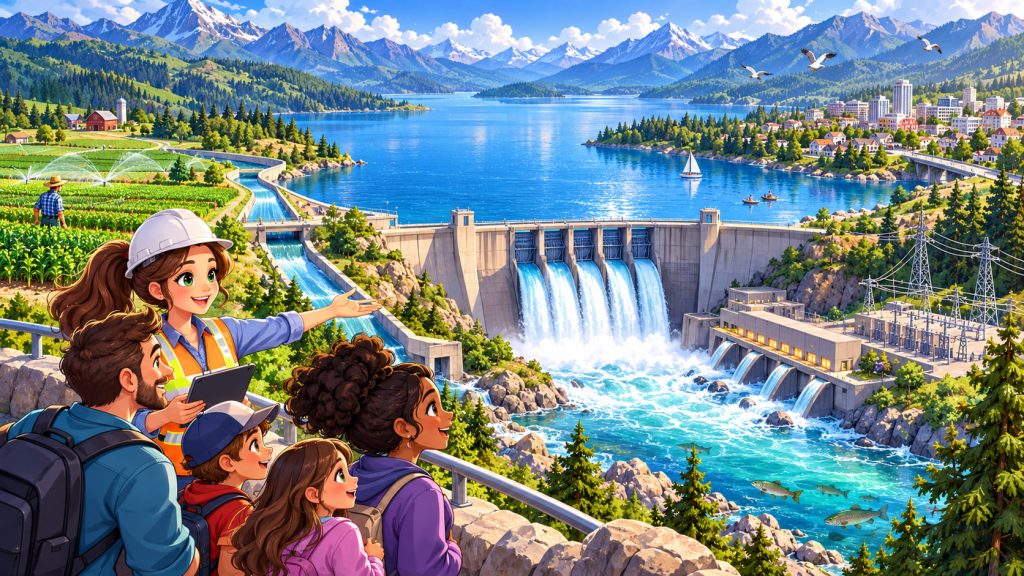
Reservoirs are among the most important pieces of water infrastructure ever created. They supply drinking water to cities, support agriculture, reduce flood risks, generate electricity, and help societies survive long dry periods.
At the same time, reservoirs can dramatically transform rivers and surrounding ecosystems. A valley that once contained forests, farms, or settlements may become a vast artificial lake, while downstream water flow can change for hundreds of kilometers.
A reservoir is therefore much more than stored water. It is part of a complex system connecting rivers, climate, energy, agriculture, ecosystems, and human communities.
What Is a Reservoir?
A reservoir is a natural or artificial body of water used for storage and controlled release. Most large reservoirs are created by constructing a dam across a river or valley.
Water gradually accumulates behind the barrier, forming an artificial lake.
The amount of water entering the reservoir depends largely on its catchment area, the surrounding region from which rainfall, snowmelt, streams, and groundwater ultimately drain toward the reservoir.
Some reservoirs are enormous. Lake Volta in Ghana, created by the Akosombo Dam, covers more than 8,000 square kilometers. Other reservoirs are relatively small and provide water for individual towns, farms, or industrial facilities.
Why Reservoirs Are Built
Reservoirs are rarely designed for only one purpose.
Many large projects combine several functions:
- Drinking-water storage
- Agricultural irrigation
- Flood control
- Electricity generation
- Industrial water supply
- Navigation
- Recreation
- Drought protection
This combination is known as multipurpose reservoir management.
A city may depend on the same reservoir that supplies farms downstream and generates electricity. Managing those competing demands can be difficult, particularly during drought.
Stored water becomes especially valuable when rainfall is seasonal or unpredictable.
Reservoirs and Drinking Water
Large cities require enormous and relatively reliable water supplies.
Reservoirs allow water collected during rainy seasons or snowmelt periods to be stored for later use. Instead of allowing all river water to flow immediately toward the sea, managers can release it gradually throughout the year.
Water from a reservoir usually requires treatment before reaching households.
Treatment systems remove sediment, microorganisms, organic material, and other contaminants before water enters drinking-water networks.
Reservoir levels must also be carefully monitored. Severe drought can reduce storage for several consecutive years, creating water shortages even in regions with sophisticated infrastructure.
How Reservoirs Support Agriculture
Irrigation is one of the world’s largest uses of freshwater.
Reservoirs make it possible to move water from periods of abundance to periods when crops actually need it.
This is especially important in regions with pronounced wet and dry seasons.
A reservoir filled by winter rain or mountain snowmelt may supply irrigation canals throughout the following spring and summer.
Reliable irrigation can dramatically increase agricultural production. However, excessive irrigation can also create problems such as waterlogging and soil salinization if drainage is poorly managed.
Hydroelectric Reservoirs
Many reservoirs generate electricity through hydropower.
Water stored at elevation possesses gravitational potential energy. When released through turbines, moving water turns generators and produces electricity.
Large hydroelectric stations can produce electricity without directly burning fossil fuels.
Reservoir hydropower also has an important advantage: output can often be adjusted relatively quickly. Operators can release more water when electricity demand rises and reduce generation when demand falls.
Some energy systems use pumped-storage hydropower. Water is pumped uphill into an upper reservoir when electricity is abundant and later released through turbines when electricity is needed.
This effectively allows water reservoirs to function as giant energy-storage systems.
Reservoirs Can Reduce Flooding
Reservoirs can provide space for temporarily storing floodwater.
Before a major storm or seasonal flood, operators may lower the water level to create additional storage capacity.
When extremely large volumes of water arrive, part of the flood can be retained and released more slowly.
This can reduce downstream flood peaks.
However, reservoirs cannot eliminate every flood risk. If a reservoir is already nearly full, or if rainfall is exceptionally intense, operators may have limited capacity to hold additional water.
Reservoir management therefore depends heavily on weather forecasting and continuous monitoring.
The Hidden Problem of Sediment
Rivers naturally transport sand, silt, clay, and gravel.
When flowing water enters a reservoir, its velocity decreases. Much of that material then settles to the bottom.
This process is called sedimentation.
Over decades, sediment can occupy an increasingly large portion of a reservoir’s storage capacity.
Some dams lose useful storage surprisingly quickly in regions with severe soil erosion.
Sediment management may involve upstream erosion control, bypass systems, flushing, dredging, or modifications to reservoir operation.
Without effective management, a reservoir designed to last for generations can gradually fill with sediment instead of water.
Not All Stored Water Is Usable
Reservoir engineers divide storage into different zones.
The lowest portion is often called dead storage. This is water below the level from which it can normally be released through standard outlets.
Dead storage can also provide space for accumulating sediment.
Above it lies usable or active storage, which operators can release for water supply, irrigation, electricity generation, or flood management.
Reservoir levels regularly rise and fall as water enters and leaves. The shoreline area exposed during these fluctuations is known as the drawdown zone.
Plants and animals living there must tolerate alternating periods of flooding and exposure.
Reservoirs Transform River Ecosystems
Building a dam changes the physical behavior of a river.
Natural rivers carry sediment, nutrients, organisms, and seasonal floods downstream. A reservoir interrupts many of these processes.
Fish migrations can be blocked. Sediment becomes trapped. Water temperature can change. Floodplain ecosystems downstream may receive less frequent flooding.
Modern water management increasingly tries to maintain an environmental flow — a pattern of water releases designed to preserve important ecological processes downstream.
This may include seasonal increases in discharge intended to imitate some aspects of natural river behavior.
Environmental flows cannot fully recreate an undammed river, but they can reduce some ecological damage.
Water Quality Can Change Inside Reservoirs
Reservoir water is often much slower-moving than river water.
During warm weather, layers of different temperatures may form. Deeper water can become colder and contain less oxygen.
Reservoirs receiving excessive nitrogen and phosphorus from farms, sewage, or urban runoff may also experience eutrophication.
This nutrient enrichment can stimulate excessive growth of algae and aquatic plants.
Some algal blooms reduce oxygen levels when organic material decomposes. Certain cyanobacteria can also produce toxins harmful to animals and humans.
Protecting reservoir water quality therefore requires managing not only the reservoir itself but the entire surrounding watershed.
Reservoirs Lose Water Through Evaporation
Large reservoirs expose enormous water surfaces to sunlight, wind, and dry air.
As a result, substantial volumes of stored water can disappear through evaporation.
Losses are especially significant in hot, dry climates.
A shallow reservoir with a very large surface area generally loses proportionally more water than a deeper reservoir storing the same volume.
Climate change may make evaporation increasingly important in regions experiencing higher temperatures and longer droughts.
Reservoirs Can Have Major Social Costs
Large reservoir projects sometimes require enormous areas of land.
Communities may have to relocate. Agricultural fields, archaeological sites, forests, roads, and entire villages can disappear beneath rising water.
The construction of major dams during the twentieth century displaced millions of people worldwide.
For this reason, modern reservoir planning increasingly considers compensation, resettlement, cultural heritage, environmental impacts, and long-term community effects.
The benefits of a reservoir can be enormous, but those benefits and costs are not always experienced by the same people.
What Water Experts Emphasize
Hydrologists and water-resource engineers generally emphasize that successful reservoirs require continuous management rather than simply building a dam and filling it with water.
Managers must balance water supply, flood protection, ecosystem requirements, sediment accumulation, energy production, safety, and changing climate conditions.
Older reservoirs are becoming especially important because many major dams built during the twentieth century are now decades old.
Maintaining them may require upgraded spillways, improved monitoring systems, sediment management, structural repairs, and revised operating rules.
The future of reservoirs will therefore depend not only on constructing new infrastructure but also on using existing water storage more efficiently and safely.
Interesting Facts
- Reservoirs can range from small farm ponds to artificial lakes covering thousands of square kilometers.
- Some reservoirs store water collected from melting mountain snow hundreds of kilometers from the cities that eventually use it.
- Sediment trapped by dams can reduce reservoir capacity while also depriving downstream deltas and coastlines of material.
- Hydroelectric reservoirs can respond quickly to changes in electricity demand.
- Pumped-storage facilities can move the same water repeatedly between upper and lower reservoirs.
- Reservoir evaporation can represent a major water loss in hot and arid climates.
- Fish ladders and bypass systems are sometimes constructed to help migrating fish move around dams.
- The deepest water in a reservoir can have very different temperature and oxygen conditions from water near the surface.
Glossary
- Dam — A barrier constructed to stop or control the movement of water, often creating a reservoir.
- Catchment Area — The land area from which water drains toward a river, lake, or reservoir.
- Hydropower — Electricity generated using the energy of moving or falling water.
- Pumped-Storage Hydropower — An energy-storage system that pumps water to a higher reservoir and later releases it through turbines.
- Sedimentation — The accumulation of particles such as sand, silt, and clay carried into a reservoir by water.
- Dead Storage — The lowest portion of reservoir water that normally cannot be released through standard outlets.
- Drawdown Zone — The shoreline area alternately exposed and submerged as reservoir water levels change.
- Environmental Flow — Water released or maintained in a river to support ecological processes and aquatic ecosystems.
- Eutrophication — Excessive nutrient enrichment of water that can cause rapid algae and plant growth.