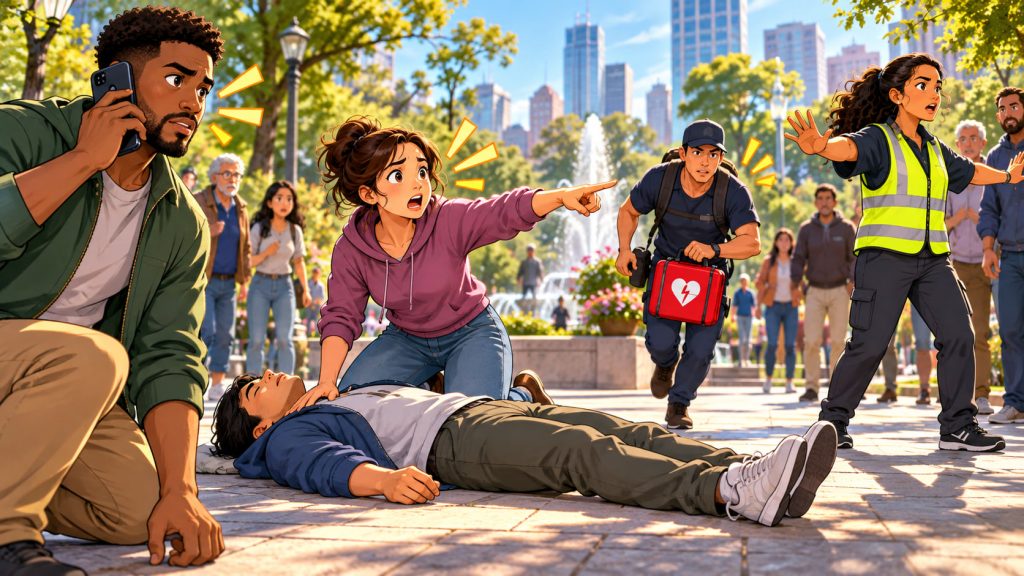
Imagine suddenly finding yourself in danger. You fall in a crowded street, witness a serious accident, or experience a medical emergency. People are nearby, yet nobody immediately steps forward to help.
Why does this happen?
Psychologists have studied how people respond to emergencies for decades. Their research reveals that the way someone asks for help can influence how quickly bystanders recognize danger and decide to act.
Surprisingly, shouting “Help!” is not always the most effective approach.
Clear instructions, direct communication, and identifying specific people can make it easier for others to respond during an emergency.
Understanding these principles could help you protect yourself, assist someone else, and respond more effectively when every second matters.
Why Do People Sometimes Ignore Cries for Help?
When an emergency happens in a public place, witnesses do not always react immediately.
One explanation is the bystander effect, a psychological phenomenon in which the presence of other people can sometimes reduce an individual’s likelihood of helping.
In a crowd, everyone may assume someone else will take responsibility.
Psychologists call this diffusion of responsibility.
People may also hesitate because they are unsure whether the situation is genuinely dangerous.
For example, someone sitting motionless on a sidewalk might be resting, injured, or unconscious.
When the situation appears ambiguous, witnesses may look toward others for clues about how to respond.
Making the emergency unmistakably clear can help overcome this uncertainty.
The Most Effective Way to Shout for Help
A loud voice can attract attention, but the words you choose matter.
Instead of repeatedly shouting “Help!”, describe what is happening and what assistance you need.
For example:
- “Help! Someone has collapsed! Call an ambulance!”
- “Fire! Everyone move away from the building!”
- “I am injured! Please call emergency services!”
- “Help! I am being threatened! Call the police!”
These statements communicate both urgency and the nature of the danger.
Short sentences are especially useful because frightened people may struggle to process complicated instructions.
A strong emergency call combines three elements: attention, information, and a specific request.
Point to One Person Instead of Shouting at Everyone
One of the most practical techniques is to address a particular bystander.
If several people are nearby, look toward one individual and give them a clear task.
For example:
“You in the blue jacket! Please call emergency services!”
Or:
“You standing near the entrance! Bring the first aid kit!”
This approach reduces uncertainty about who should take action.
It also creates a recognizable responsibility for a particular person.
In emergency training, the practice of confirming that a specific person has received and understood an instruction is related to closed-loop communication.
For example, after asking someone to call emergency services, request confirmation that the call has been made.
If they cannot help, choose another person immediately.
Why Clear Instructions Work Better Than Panic
Danger can activate the body’s fight-or-flight response.
Adrenaline increases alertness, heart rate, and readiness for physical action.
However, intense fear can also make it difficult to think clearly, remember information, or communicate effectively.
This is why simple instructions are valuable.
Rather than trying to explain everything simultaneously, focus on the most urgent action.
Tell others what happened, where help is needed, and what they should do.
You do not need to appear perfectly calm.
Even when your voice is shaking, a direct and understandable request can guide other people toward useful action.
How to Call Emergency Services Correctly
When immediate professional assistance is necessary, calling emergency services should be a priority.
Emergency telephone numbers vary by country.
Examples include:
- 112 in European Union countries
- 911 in the United States and Canada
- 999 or 112 in the United Kingdom
The emergency dispatcher will normally ask questions to understand the situation and coordinate an appropriate response.
Provide the most important information first:
- Your exact location or the nearest recognizable landmark.
- What has happened.
- How many people are injured or in danger.
- Whether there are immediate hazards.
- Any other details requested by the dispatcher.
Follow the dispatcher’s instructions and remain on the line until told otherwise, if it is safe to do so.
What to Do When Nobody Responds
Sometimes the first person you approach may freeze, misunderstand, or refuse to get involved.
Do not spend valuable time arguing.
Address another person immediately and repeat a clear instruction.
If possible, call emergency services yourself.
Move toward a safer and more visible location when circumstances allow.
Shouting, waving your arms, using a whistle, or activating a personal alarm may help attract attention.
However, if someone is threatening you, making noise might increase the danger.
In that situation, prioritize escape, reaching a secure location, and contacting emergency services safely.
How to Ask for Help in Different Emergencies
Different situations require different responses.
Medical emergency: Tell a specific person to call emergency services. If someone is unresponsive and not breathing normally, follow dispatcher instructions for CPR and ask another person to retrieve an automated external defibrillator (AED) if available.
Fire: Warn others immediately, move away from danger, and contact the fire service from a safe location. Do not return inside a burning building.
Personal attack: Move toward safety, attract attention when appropriate, and ask a particular person to call the police. Avoid unnecessary confrontation.
Water emergency: Alert a lifeguard or emergency services. Throw a flotation device or use a rescue aid from a safe position. Do not enter dangerous water unless properly trained.
The priority is always to obtain assistance without creating additional victims.
How to Attract Attention When You Are Alone
An emergency can happen in a remote location where nobody is within shouting distance.
Preparation becomes especially important.
A charged mobile phone, an accessible emergency-call function, and location-sharing capabilities can make obtaining assistance easier.
Many smartphones include built-in emergency SOS features.
In remote wilderness areas, satellite communication devices or personal locator beacons may provide additional options.
If rescue personnel are searching for you, a whistle, flashlight, or other visible signal can help them locate you.
Conserve energy and follow available emergency guidance rather than moving into greater danger.
How Psychology Explains Emergency Reactions
Social psychologists John Darley and Bibb Latané conducted influential research into how the presence of other witnesses can affect emergency intervention.
Their experiments helped explain why individuals sometimes hesitate to act when responsibility appears shared.
Another relevant concept is social proof, the tendency to interpret other people’s behavior as information about what is appropriate.
If everyone appears unconcerned, an uncertain witness may underestimate the seriousness of a situation.
Clear verbal communication helps establish that assistance is genuinely needed.
However, research also shows that crowds can respond cooperatively, particularly when danger is obvious.
The presence of other people is not automatically an obstacle; clear coordination can turn witnesses into effective helpers.
How to Help Someone Who Is Calling for Assistance
Being a helpful witness requires situational awareness, the ability to recognize what is happening and identify important risks.
If someone calls for help, assess immediate dangers before approaching.
Listen carefully to what they need.
Contact emergency services when necessary, and provide practical assistance within your abilities.
If others are present, divide tasks clearly.
One person can make the emergency call while another retrieves equipment or guides responders to the correct location.
Avoid moving a seriously injured person unless remaining in place exposes them to immediate danger.
Practice Emergency Communication Before You Need It
People often respond better to emergencies when they have already considered what to do.
You can practice simple emergency phrases and learn how to activate your phone’s emergency functions.
Know the emergency number in your country and become familiar with the location of nearby exits and first aid equipment.
First aid and CPR training can also build practical skills and confidence.
The goal is not to memorize complicated speeches, but to develop a few reliable actions that remain useful under pressure.
Interesting Facts
- The bystander effect was extensively studied in experimental social psychology during the 1960s.
- Assigning an emergency task to one identifiable person can reduce uncertainty about responsibility.
- A clear description of danger can help witnesses distinguish an emergency from an ordinary situation.
- Emergency dispatchers can provide instructions for assisting someone before professional responders arrive.
- Many modern smartphones can initiate emergency calls without navigating through ordinary phone menus.
- Whistles can be useful for attracting attention when shouting becomes difficult.
- Some public locations have automated external defibrillators designed for use by people without extensive medical training.
- First aid training includes communicating clearly and checking for dangers before providing assistance.
Glossary
- Bystander Effect — A psychological phenomenon in which the presence of other witnesses may reduce an individual’s likelihood of intervening.
- Diffusion of Responsibility — The tendency for individuals to feel less personally responsible when other people are also present.
- Closed-Loop Communication — A method of communication in which instructions are acknowledged and their completion is confirmed.
- Fight-or-Flight Response — The body’s automatic physiological reaction to perceived danger or threat.
- Emergency Dispatcher — A trained professional who receives emergency calls, gathers information, and coordinates emergency responses.
- Automated External Defibrillator (AED) — A portable device that analyzes heart rhythm and can deliver an electrical shock when appropriate during cardiac arrest.
- Social Proof — The tendency to use other people’s behavior as a guide when interpreting uncertain situations.
- Situational Awareness — The ability to recognize, understand, and respond appropriately to important elements of the surrounding environment.