The Arctic is one of the most mysterious regions on Earth. Its enormous ice-covered landscapes, frozen oceans, and remote glaciers conceal an extraordinary world that scientists are only beginning to understand.
Beneath the ice lie ancient landscapes, microscopic life forms, geological structures, and natural records preserving information about Earth’s distant past.
Some discoveries reveal how our planet looked thousands of years ago. Others help scientists understand climate change, marine ecosystems, and the possibility of life in extreme environments.
Arctic ice is far more than frozen water. It is a natural archive, an ecological habitat, and a gateway to some of Earth’s least explored environments.
Modern satellites, underwater robots, and advanced drilling technologies are gradually uncovering what has remained hidden beneath this frozen region for millennia.
What Exactly Is Hidden Beneath Arctic Ice?
The Arctic contains several different types of frozen environments.
Sea ice forms when ocean water freezes. It floats on the surface, often covering an ocean thousands of meters deep.
The Greenland ice sheet is fundamentally different. It is an enormous mass of glacial ice resting on land, reaching more than three kilometers thick in some locations.
Beyond these frozen surfaces lie:
- Ancient valleys and mountain landscapes
- Deep ocean basins and underwater ridges
- Microscopic organisms adapted to extreme cold
- Records of prehistoric atmospheric conditions
- Frozen organic material and archaeological remains
- Water trapped beneath glaciers
Each environment preserves different evidence about Earth’s history.
A Hidden Ocean Full of Life
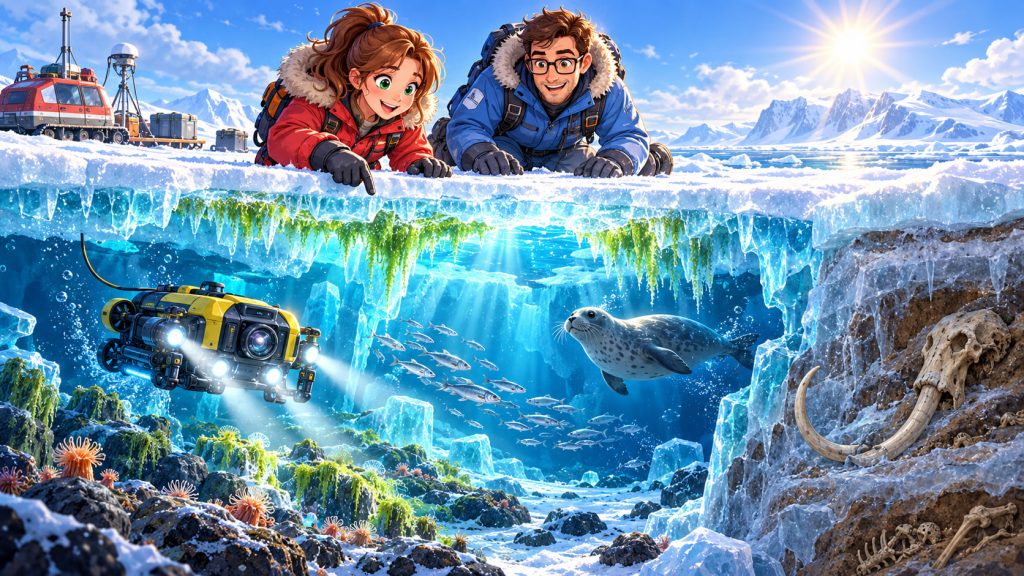
The Arctic Ocean remains a functioning marine ecosystem even when much of its surface is covered by ice.
Sunlight can penetrate thinner ice and snow, supporting microscopic algae near the surface.
Specialized ice algae grow on the underside of sea ice and within its internal structures.
These organisms support food webs involving zooplankton, fish, seabirds, and marine mammals.
Tiny passages filled with salty liquid, called brine channels, can also provide habitats for microorganisms.
These communities survive in conditions that would be impossible for many other organisms.
The frozen surface of the Arctic Ocean does not separate the environment from life. It supports an unusual ecosystem adapted to darkness and extreme cold.
Ancient Atmospheres Preserved Inside Ice
Some of the Arctic’s most valuable scientific discoveries come from Greenland’s enormous glaciers.
Scientists drill cylindrical samples called ice cores from deep within the ice.
These cores contain ancient snow layers compressed over thousands of years.
Trapped air bubbles preserve samples of Earth’s former atmosphere.
Researchers can measure historical concentrations of carbon dioxide, methane, and other gases.
Dust, volcanic particles, and chemical compounds provide additional information about environmental conditions.
This research contributes to paleoclimate science, the study of Earth’s past climate.
Greenland ice cores have provided exceptionally detailed records of major climate changes extending back more than 100,000 years.
Ancient Landscapes Beneath Greenland
Greenland’s ice sheet conceals an extraordinary geological world.
Radar measurements have revealed valleys, mountains, and extensive drainage systems buried beneath the ice.
One remarkable discovery is a vast canyon stretching approximately 750 kilometers beneath Greenland.
Scientists believe the canyon formed through ancient geological and river processes before the modern ice sheet developed.
Researchers have also identified evidence of former vegetation in sediments recovered from beneath Greenland’s ice.
These findings demonstrate that portions of the island experienced dramatically different environmental conditions in the distant past.
The landscape beneath Greenland contains evidence of a world that existed long before today’s extensive glaciation.
Lakes Hidden Beneath the Ice
Liquid water can sometimes exist underneath thick glaciers despite extremely low surface temperatures.
A subglacial lake forms when water accumulates between the ice and the underlying ground.
Pressure, geothermal heat, and friction can contribute to melting at the base of glaciers.
Scientists have identified subglacial water systems in Greenland, including lakes that can fill and drain.
These water bodies influence how ice moves across the underlying landscape.
They may also contain microorganisms adapted to isolated, cold, and dark environments.
Studying them helps researchers understand both glacier dynamics and the limits of life under extreme conditions.
Ancient Microorganisms Frozen in Time
Polar ice and frozen ground can preserve microscopic biological material for extraordinarily long periods.
Scientists have recovered bacteria, microbial DNA, and other biological traces from frozen environments.
Some microorganisms remain viable after prolonged freezing under suitable conditions.
These discoveries interest researchers studying biological survival, genetics, and adaptation.
However, not every microorganism found in ancient ice is alive, and the recovery of microbial DNA does not necessarily indicate that an organism remains infectious.
Understanding these frozen biological archives may help explain how life responds to extreme environmental stress.
Prehistoric Animals and Human History
The Arctic’s permanently frozen ground has preserved remarkable evidence of ancient ecosystems.
This frozen soil is known as permafrost.
In Siberia and other northern regions, scientists have discovered exceptionally preserved mammoth remains, prehistoric plants, and ancient animal tissues.
Frozen ground has also protected archaeological objects, including tools and other traces of human activity.
These finds reveal how prehistoric animals and human communities adapted to cold environments.
As permafrost thaws, additional remains can become exposed.
However, thawing also threatens to destroy valuable archaeological and biological evidence before researchers can document it.
Methane and Carbon Locked in Frozen Ground
Arctic permafrost contains enormous quantities of organic carbon accumulated over thousands of years.
When permanently frozen soil thaws, microorganisms can decompose previously frozen organic matter.
This process may release carbon dioxide and methane into the atmosphere.
Some Arctic seabed sediments also contain methane hydrates, ice-like substances that trap methane molecules within crystalline structures.
These deposits are scientifically important because changing environmental conditions can affect their stability.
The Arctic’s frozen carbon reservoirs play an important role in Earth’s climate system.
Their behavior is a major subject of ongoing scientific investigation.
Underwater Mountains and Unexplored Seafloors
The Arctic Ocean contains dramatic geological structures hidden beneath deep water and floating ice.
One remarkable feature is the Lomonosov Ridge, an underwater mountain system extending approximately 1,800 kilometers across the Arctic Ocean.
The seafloor also contains deep basins, sediment deposits, and geological formations revealing the region’s tectonic history.
Exploring these environments is difficult because thick ice limits access for research ships.
Scientists increasingly use autonomous underwater vehicles to map the seabed and study the water column beneath the ice.
These robots can collect measurements in locations that would be dangerous or inaccessible for conventional expeditions.
Why Melting Arctic Ice Changes Everything
One of the most important properties of Arctic ice is its ability to reflect sunlight.
This reflectivity is called albedo.
Bright snow and ice reflect substantial amounts of incoming solar radiation, while darker ocean water absorbs more energy.
When sea ice retreats, greater heat absorption can accelerate regional warming.
The melting of floating sea ice does not directly cause significant sea-level rise because it already displaces seawater.
However, the loss of land-based ice from Greenland adds water to the ocean and contributes to rising global sea levels.
These different processes make understanding Arctic ice essential for predicting future environmental changes.
Expert Perspective: Why Arctic Ice Research Matters
Glaciologist Richard Alley of Pennsylvania State University has contributed extensively to research on ice sheets and ancient climate records.
His work has helped demonstrate how polar ice preserves evidence of abrupt climate changes and how ice sheets respond to environmental conditions.
A fundamental lesson from polar research is that ice can record the past while simultaneously influencing the planet’s future.
Protecting and studying Arctic environments helps scientists understand both Earth’s climate history and the changes unfolding today.
Interesting Facts
- The Greenland ice sheet covers approximately 1.7 million square kilometers.
- Greenland’s ice reaches more than three kilometers thick in some areas.
- Scientists have discovered an enormous canyon buried beneath Greenland’s ice.
- Some microorganisms survive within tiny salty channels inside sea ice.
- Greenland ice cores preserve ancient air bubbles containing information about past atmospheric conditions.
- Mammoth remains have been preserved for thousands of years in Arctic permafrost.
- The Lomonosov Ridge extends across a large portion of the Arctic Ocean.
- The Arctic Ocean contains deep underwater basins beneath its seasonally changing ice cover.
- Floating sea ice and land-based glaciers affect global sea levels differently.
- Underwater robots can investigate Arctic environments without requiring continuous access to the surface.
Glossary
- Sea Ice — Frozen seawater that floats on the ocean surface.
- Ice Sheet — A vast mass of glacial ice covering an extensive land area.
- Ice Algae — Microscopic photosynthetic organisms that grow in association with sea ice.
- Brine Channels — Tiny networks of concentrated salty water within sea ice.
- Ice Core — A cylindrical ice sample extracted to investigate past environmental conditions.
- Paleoclimate — The study of Earth’s climate during periods before modern instrumental observations.
- Subglacial Lake — A body of liquid water located underneath a glacier or ice sheet.
- Permafrost — Ground that remains at or below freezing temperature for at least two consecutive years.
- Methane Hydrates — Ice-like crystalline substances containing methane trapped within water-molecule structures.
- Autonomous Underwater Vehicles — Robotic underwater craft that perform exploration and scientific measurements without continuous direct human control.
- Albedo — The proportion of incoming sunlight reflected by a surface.