Nature continues to surprise scientists. Even after centuries of biological research and technological progress, researchers are discovering extraordinary abilities in familiar animals, identifying previously unknown species, and uncovering hidden processes that shape Earth’s ecosystems.
Between 2023 and 2026, several remarkable discoveries transformed our understanding of the natural world.
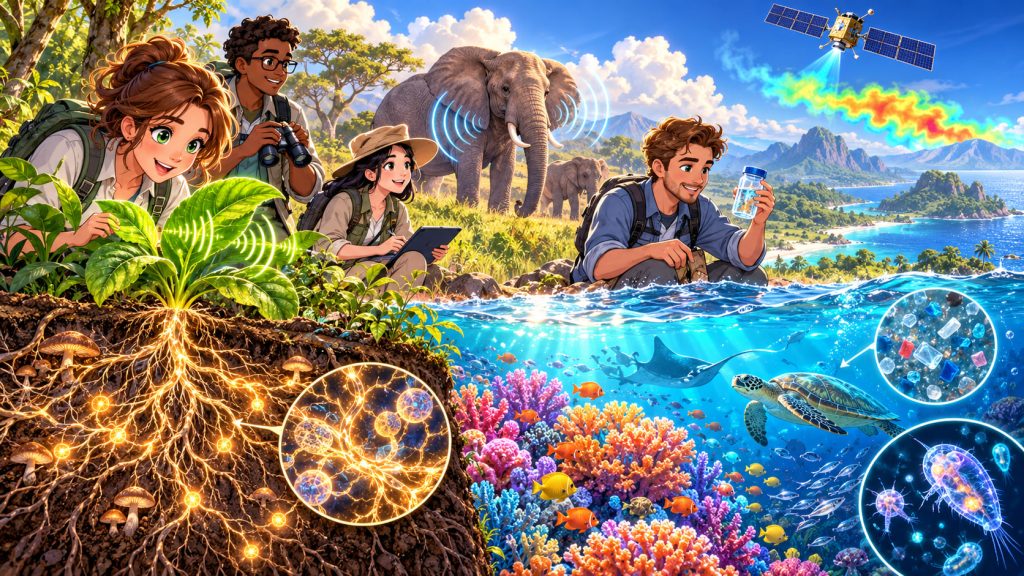
Scientists found that stressed plants produce detectable sounds, elephants use individual-specific calls, and microscopic marine organisms possess previously unrecognized biological machinery.
Meanwhile, new environmental research revealed enormous quantities of previously difficult-to-detect plastic pollution and important gaps in global conservation efforts.
These discoveries show that Earth still contains extraordinary biological mysteries, even in environments that scientists have studied for decades.
1. Scientists Discovered That Plants Produce Sounds When Stressed
In 2023, researchers at Tel Aviv University demonstrated that certain plants produce airborne sounds when experiencing stress.
Experiments involving tomato and tobacco plants revealed that dehydration and physical injury can trigger distinctive ultrasonic emissions.
These sounds occur at frequencies above the normal range of human hearing.
Using specialized microphones and machine-learning systems, scientists distinguished sounds produced by plants experiencing different conditions.
One proposed explanation involves microscopic air bubbles forming or collapsing within water-conducting plant tissues.
The discovery opened new possibilities for monitoring plant health.
In the future, agricultural sensors could potentially detect water stress before obvious visual symptoms appear.
2. Elephants May Address Each Other Using Name-Like Calls
A remarkable 2024 study revealed new evidence about elephant communication.
Researchers studying wild African savanna elephants in Kenya discovered that the animals produce calls containing information associated with particular individuals.
Using acoustic analysis and playback experiments, scientists found that elephants responded differently to calls directed toward them compared with calls intended for other elephants.
The findings suggest that elephants use individual-specific vocal labels resembling names.
Behavioral ecologist Michael Pardo and his colleagues demonstrated that these calls do not appear to depend simply on imitating another elephant’s voice.
This represents an important advance in understanding animal communication.
Elephant societies may possess more sophisticated systems of individual recognition than previously demonstrated.
3. A New Cellular Structure Was Identified in Marine Algae
One of the most significant biological discoveries of 2024 involved microscopic marine algae.
Scientists investigating Braarudosphaera bigelowii identified a specialized cellular structure called a nitroplast.
This structure enables the organism to obtain usable nitrogen through nitrogen fixation, the biological conversion of atmospheric nitrogen into compounds that cells can use.
Most plants cannot perform this process independently and rely on microorganisms or available nitrogen compounds.
The newly characterized structure originated from a nitrogen-fixing bacterium that became closely integrated into its algal host.
Its discovery provides evidence of an evolutionary transition in which a formerly independent organism became a functional cellular component.
This finding helps scientists understand how complex cells acquire new biological capabilities.
4. The World’s Largest Known Coral Colony Was Discovered
In October 2024, a scientific expedition in the Solomon Islands discovered an exceptionally large coral colony.
Measuring approximately 34 meters long and 32 meters wide, the structure was identified as Pavona clavus.
Researchers estimated that the enormous colony could be around 300 years old.
Although it resembles a gigantic underwater rock, it consists of countless tiny coral animals living together.
The discovery was especially significant because coral reefs worldwide are facing increasing environmental pressure.
Satellite observations later established that approximately 84% of the world’s coral reef area experienced bleaching-level heat stress during the global event spanning 2023 to 2025.
Coral bleaching occurs when stressed corals lose the symbiotic algae responsible for much of their coloration and energy supply.
The discovery demonstrates both the remarkable longevity of some coral colonies and the importance of protecting vulnerable marine ecosystems.
5. Hundreds of Previously Unknown Marine Species Were Found
The ocean remains one of Earth’s least completely explored environments.
In March 2025, the Ocean Census initiative announced the discovery of 866 marine species previously unknown to science.
These discoveries resulted from international expeditions and scientific examination of marine organisms.
The newly documented life forms included unusual animals from deep and relatively unexplored habitats.
Identifying an organism is only the beginning.
Scientists must examine its anatomy, compare it with known species, and determine whether it represents a genuinely new species.
Modern DNA barcoding can assist this work by comparing characteristic genetic sequences.
Every newly identified species contributes information about marine biodiversity, evolutionary history, and ecosystem relationships.
6. Scientists Mapped Hidden Underground Fungal Diversity
One of the most important environmental discoveries of 2025 concerned organisms living beneath our feet.
Researchers produced detailed global predictions of biodiversity among mycorrhizal fungi.
These fungi form beneficial relationships with plant roots, helping plants obtain water and nutrients while receiving carbon compounds in return.
Scientists analyzed data from approximately 25,000 soil samples containing more than 2.8 billion fungal DNA sequences.
Their findings identified previously underappreciated centers of underground biodiversity.
Remarkably, less than 10% of the predicted fungal species-richness hotspots were located within existing protected areas.
This revealed a major conservation gap: protecting visible plants and animals does not automatically protect the most biologically valuable underground ecosystems.
The research provides new opportunities for conservation planning and ecosystem restoration.
7. Scientists Found Enormous Quantities of Nanoplastics in the Atlantic Ocean
Plastic pollution research reached another important milestone in 2025.
Scientists examining the North Atlantic detected nanoplastics throughout the water column, including near the surface and at considerable depths.
These particles are smaller than ordinary microplastics and are difficult to measure using conventional techniques.
Researchers identified several plastic types, including polyethylene terephthalate, polystyrene, and polyvinyl chloride.
Their measurements suggested that approximately 27 million metric tons of nanoplastics could exist in the mixed surface layer of the temperate-to-subtropical North Atlantic.
The findings revealed a substantial reservoir of plastic pollution that earlier surveys had largely missed.
Nanoplastics can be ingested by marine organisms, although their ecological effects depend on particle characteristics, exposure, and environmental conditions.
8. Satellites Revealed Previously Hidden Methane Emissions
New satellite technologies have transformed how scientists observe greenhouse gases.
In recent years, instruments including NASA’s EMIT and dedicated methane-monitoring satellites have identified concentrated emissions from industrial infrastructure.
These concentrated releases are commonly called methane plumes.
Methane is a powerful greenhouse gas, and large leaks can significantly contribute to atmospheric warming.
Advanced instruments detect characteristic patterns in reflected sunlight to identify methane concentrations.
This allows scientists to locate major emission sources associated with oil and gas operations, waste facilities, and other activities.
The major breakthrough is the ability to identify specific emission sources rather than relying entirely on broad regional estimates.
These measurements can help governments and operators prioritize leak detection and repairs.
How These Discoveries Are Changing Environmental Science
Recent discoveries have been driven by increasingly powerful scientific tools.
Artificial intelligence can identify patterns in animal vocalizations and plant sounds.
Genetic analysis reveals organisms that traditional observation may overlook.
Satellites measure environmental changes across vast geographical areas, while underwater exploration reveals ecosystems previously inaccessible to researchers.
Together, these methods are transforming conservation from a discipline focused mainly on visible organisms into one capable of investigating hidden biological and environmental processes.
The most important lesson is that effective environmental protection depends on understanding ecosystems at every scale, from microscopic organisms to the entire planet.
Interesting Facts
- Stressed tomato plants can emit ultrasonic clicks that humans cannot hear unaided.
- African elephants can distinguish calls directed toward them from calls intended for other elephants.
- The nitroplast discovery revealed a previously unrecognized form of cellular integration.
- The giant coral colony discovered in the Solomon Islands is longer than a blue whale.
- The Ocean Census initiative announced 866 new marine species discoveries in March 2025.
- A 2025 global study analyzed more than 2.8 billion fungal DNA sequences.
- Nanoplastics have been detected in Atlantic waters far below the ocean surface.
- Satellite instruments can identify concentrated methane emissions from individual industrial locations.
Glossary
- Ultrasonic Emissions — Sounds produced at frequencies higher than the normal upper limit of human hearing.
- Individual-Specific Vocal Labels — Vocal signals associated with particular individuals and potentially used to address them.
- Nitroplast — A nitrogen-fixing cellular organelle identified in certain marine algae.
- Nitrogen Fixation — The biological conversion of atmospheric nitrogen into compounds usable by living organisms.
- Coral Bleaching — The loss of symbiotic algae or their pigments from coral tissues, commonly triggered by environmental stress.
- DNA Barcoding — A method of identifying organisms by comparing selected genetic sequences.
- Mycorrhizal Fungi — Fungi that form beneficial relationships with plant roots and assist with nutrient acquisition.
- Nanoplastics — Extremely small plastic particles, generally smaller than one micrometer.
- Methane Plumes — Concentrated streams or clouds of methane gas released into the atmosphere.