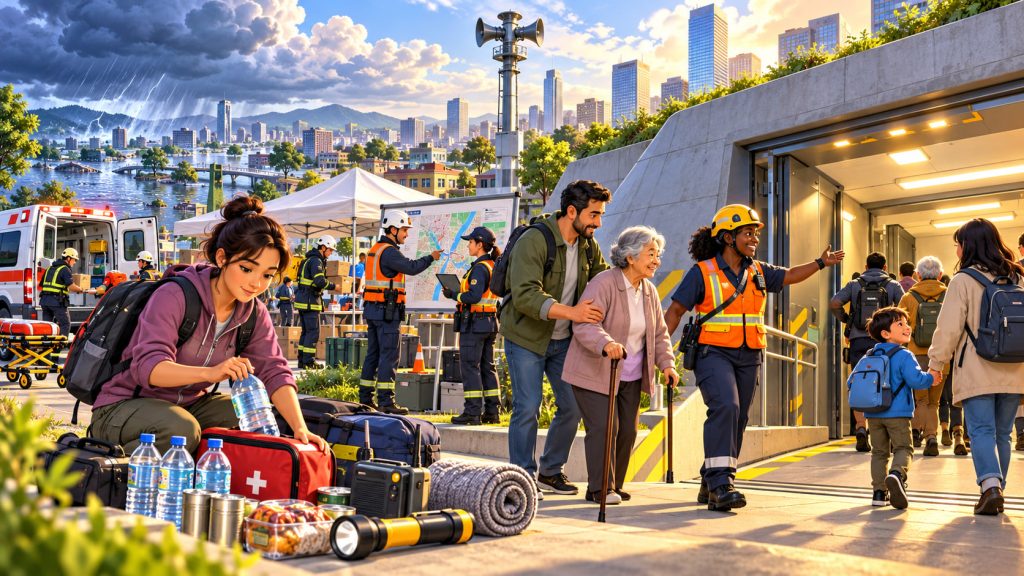
Natural disasters, industrial accidents, military conflicts, and major infrastructure failures can threaten entire communities with little warning.
When these situations occur, firefighters, medical teams, and other emergency services become essential. However, protecting the population requires much more than responding after danger appears.
Countries need organized systems that warn civilians, coordinate emergency operations, provide shelter, and help communities survive extraordinary circumstances.
This is the fundamental purpose of civil defense.
Civil defense is a coordinated system of measures designed to protect civilian populations, reduce casualties, and maintain essential services during emergencies and armed conflicts.
Although its historical development is closely connected with warfare, modern civil defense often operates within broader disaster preparedness and emergency management systems.
What Is Civil Defense?
Civil defense involves organized activities intended to safeguard people and civilian infrastructure from major threats.
These activities can include:
- Emergency warnings and public information
- Evacuation planning
- Protective shelters
- Search and rescue operations
- Emergency medical assistance
- Distribution of food and drinking water
- Protection of critical infrastructure
- Support for displaced populations
The responsibilities of civil defense organizations vary between countries.
Some governments maintain specialized civil protection agencies, while others distribute these functions among emergency management authorities, local governments, military support units, and humanitarian organizations.
The central objective is to minimize human suffering and maintain public safety when ordinary services become overwhelmed.
How Civil Defense Developed
Modern civil defense systems expanded significantly during the twentieth century.
During World War II, many countries established civilian protection programs to reduce casualties from aerial bombardment.
Britain developed extensive Air Raid Precautions services, involving air raid wardens, emergency shelters, firefighting assistance, and public safety education.
During the Cold War, civil defense planning increasingly addressed the possibility of nuclear conflict.
Governments constructed shelters, installed warning sirens, and distributed emergency preparedness instructions.
Over time, many civil defense institutions expanded their responsibilities to include natural disasters, technological accidents, and other civilian emergencies.
Today, their effectiveness depends on cooperation between public authorities, emergency professionals, and ordinary residents.
Early Warning Systems: The First Line of Protection
One of the most important functions of civil defense is providing timely information about approaching danger.
An early warning system combines hazard monitoring, risk assessment, communication technology, and public response procedures.
Warning systems may use:
- Mobile emergency alerts
- Outdoor sirens
- Radio and television broadcasts
- Weather monitoring networks
- Dedicated public warning applications
For example, Japan uses sophisticated earthquake warning technology that can provide seconds of notice before strong shaking reaches some locations.
Although this warning period is often extremely short, it may allow people to take immediate protective action.
Tsunami warning networks can provide additional time for coastal evacuation when conditions permit.
An effective warning is useful only when people understand what it means and know how to respond.
Why Emergency Shelters Are Important
Protective shelters provide temporary refuge when remaining in ordinary buildings or outdoor areas becomes dangerous.
Their design depends on the threat.
Storm shelters are constructed to withstand severe winds and flying debris.
Civilian protection shelters in conflict zones may incorporate reinforced walls, protected entrances, and ventilation systems.
During some emergencies, authorities may recommend shelter-in-place, meaning people should remain inside a suitable building rather than attempt to leave.
For example, during certain hazardous chemical releases, staying indoors and following instructions about ventilation may reduce exposure.
During a radiological emergency, moving to the interior or basement of a substantial building can provide protection from radioactive fallout.
Different hazards require different protective actions.
There is no single sheltering strategy that is appropriate for every emergency.
Evacuation: Moving People Away From Danger
In some situations, remaining in place is more dangerous than leaving.
Wildfires, severe flooding, approaching hurricanes, and certain industrial emergencies may require evacuation.
Authorities establish an evacuation route to help people move toward safer areas.
Successful evacuation planning must account for transportation availability, road capacity, medical needs, and people who require additional assistance.
Hospitals, nursing homes, schools, and other institutions often need specialized procedures.
Pets and service animals also require consideration.
The effectiveness of an evacuation depends heavily on whether people receive clear instructions early enough to act.
What Happens Behind the Scenes During an Emergency?
Major emergencies require cooperation among numerous organizations.
A local or regional emergency operations center may coordinate information, resources, and strategic decisions.
Emergency managers use these centers to communicate with police, firefighters, healthcare providers, utility operators, transportation authorities, and humanitarian agencies.
For example, after a major earthquake, one team may assess damaged buildings while another organizes temporary accommodation.
Medical personnel establish treatment priorities, engineers inspect infrastructure, and logistics teams arrange essential supplies.
Without coordination, different organizations may duplicate tasks while important needs remain unmet.
Civil defense depends on organized communication as much as specialized rescue equipment.
How Ordinary People Can Prepare
Personal preparedness forms an important part of an effective civil defense system.
Households should understand the most likely hazards in their region and develop realistic plans.
A basic emergency kit may contain:
- Drinking water and nonperishable food
- Flashlights and spare batteries
- A battery-powered or hand-crank radio
- Essential medications and first-aid supplies
- Copies of important documents
- A portable phone charger
- Necessary supplies for children, older adults, and pets
Many emergency management agencies recommend keeping enough basic supplies for at least 72 hours, while some situations require longer preparation.
Households should also identify safe meeting locations and establish methods for contacting relatives if mobile networks become unavailable.
The Role of Volunteers and Local Communities
Civil defense is not exclusively the responsibility of government agencies.
Volunteers can support evacuation centers, distribute essential supplies, assist vulnerable residents, and help communities recover after disasters.
However, specialized rescue operations require appropriate training and authorization.
Former FEMA Administrator Craig Fugate promoted the importance of a whole-community approach to emergency management.
This approach recognizes that businesses, nonprofit organizations, neighborhood networks, and individual residents all contribute to disaster preparedness.
The underlying principle is community resilience: the ability of a community to withstand disruption, adapt, and recover.
Strong social connections can make a significant difference, particularly when professional assistance is delayed.
Protecting Critical Infrastructure
Modern societies depend on interconnected infrastructure systems.
Electricity supports hospitals, communications, water treatment, refrigeration, and transportation.
A prolonged power failure can therefore affect many services simultaneously.
Civil defense planning must consider the protection and restoration of:
- Electrical networks
- Drinking water systems
- Hospitals and emergency clinics
- Communication networks
- Roads, bridges, and transportation hubs
- Food distribution facilities
Backup generators, redundant communication equipment, emergency fuel supplies, and alternative transportation arrangements can reduce the consequences of infrastructure failures.
An effective emergency response also prioritizes restoring essential services as conditions become safe.
How Technology Is Changing Civil Defense
Modern technology has expanded the capabilities of emergency management organizations.
Satellites provide information about wildfires, flooding, storms, and damaged infrastructure.
Drones can help trained responders survey inaccessible areas and locate people in certain rescue situations.
Geographic information systems allow emergency planners to map hazards, populations, evacuation routes, and critical facilities.
Artificial intelligence can assist with analyzing weather information, satellite imagery, and large datasets.
However, technology alone cannot guarantee public safety.
Warnings must remain accessible to people without smartphones, reliable electricity, or internet connections.
Why Civil Defense Remains Essential
Disasters differ in their causes, but they frequently create similar challenges: disrupted communications, damaged infrastructure, shortages of essential supplies, and urgent medical needs.
A comprehensive all-hazards approach develops emergency capabilities that can support responses to many different threats.
Instead of preparing independently for every possible disaster, communities establish flexible systems for warning, evacuation, shelter, communication, and recovery.
Effective civil defense combines professional planning, reliable infrastructure, public education, and individual preparedness.
The goal is not to eliminate every danger, but to reduce preventable losses and help communities respond effectively when emergencies occur.
Interesting Facts
- Civil defense programs expanded rapidly during World War II as governments sought to protect civilians from aerial attacks.
- Japan operates an earthquake early warning system capable of detecting seismic activity and issuing rapid alerts.
- Some countries maintain public shelters that serve everyday civilian purposes during normal conditions.
- Emergency warning sirens may use different patterns to communicate different threats, depending on national and local systems.
- Large-scale emergency exercises sometimes involve hospitals, utility companies, transportation networks, and thousands of participants.
- The Netherlands developed extensive flood protection infrastructure following the devastating North Sea flood of 1953.
- Modern satellites can help emergency teams assess wildfire damage and flooding without immediately entering hazardous areas.
- Community volunteers can assist professional responders with logistics, public information, and support for displaced residents.
Glossary
- Civil Defense — Organized measures intended to protect civilian populations and essential services during emergencies and armed conflicts.
- Early Warning System — A coordinated system that detects potential hazards and communicates timely warnings to people at risk.
- Shelter-in-Place — A protective action requiring people to remain inside a suitable building during certain emergencies.
- Evacuation Route — A designated or recommended path used to move people away from dangerous areas.
- Emergency Operations Center — A facility where authorities coordinate information, resources, and strategic decisions during emergencies.
- Emergency Kit — A collection of essential supplies prepared for use during disasters or major disruptions.
- Community Resilience — The ability of a community to withstand emergencies, adapt to changing conditions, and recover afterward.
- All-Hazards Approach — An emergency management strategy that develops capabilities applicable to multiple types of disasters and threats.