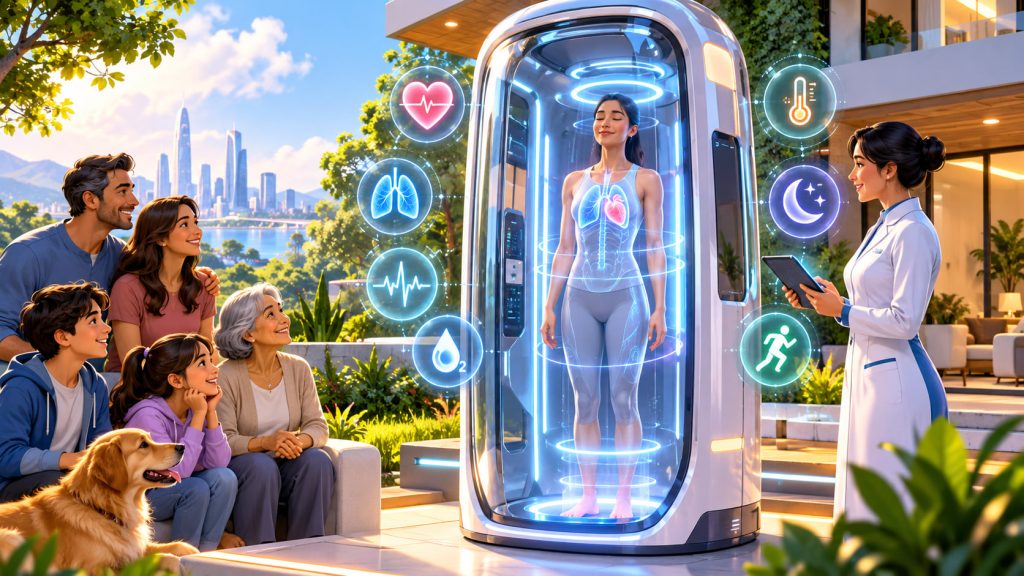
Imagine stepping into a small futuristic capsule outside your house. Within minutes, intelligent sensors measure your vital functions, analyze your physical condition, and provide personalized recommendations for improving your health.
The system notices changes in your blood pressure, evaluates your heart rhythm, checks your body composition, and compares the results with previous measurements.
An artificial intelligence assistant then explains what deserves attention, recommends healthier habits, and connects you with a medical professional when necessary.
This concept may sound like science fiction, but many of the technologies required to create such a system already exist.
The real question is no longer whether we can build an intelligent health capsule, but how accurately, safely, and economically we can make it work.
What Is a Health Capsule?
A health capsule is a proposed automated station that combines medical sensors, artificial intelligence, and digital health monitoring in one compact structure.
Its primary purpose would be preventive screening, identifying potential health problems before noticeable symptoms develop.
Unlike a traditional hospital examination, many basic measurements could be performed without direct assistance from medical personnel.
A modern capsule could combine:
- Blood pressure and heart rate monitoring
- Blood oxygen measurements
- Heart rhythm analysis
- Body composition assessment
- Skin imaging
- Temperature measurement
- Respiratory monitoring
- Digital health consultations
Results could automatically appear in a secure personal health profile.
Instead of visiting a clinic for every routine measurement, people could monitor important health indicators close to home.
The Technology Already Exists
Several components of the health capsule are already used in modern healthcare.
Self-service medical stations can measure blood pressure, weight, and other health indicators.
A study of American retail health kiosks analyzed approximately 1.27 million users who underwent blood pressure measurements between 2017 and 2024.
More sophisticated preventive screening services, including Neko Health, combine advanced body imaging, cardiovascular measurements, blood testing, and professional medical interpretation.
These systems demonstrate that multiple diagnostic technologies can operate together in a coordinated environment.
The next engineering step would be integrating suitable instruments into a compact, standardized, automated station.
What Could a Health Capsule Actually Measure?
The simplest measurements involve vital signs, including heart rate, blood pressure, temperature, and respiratory rate.
Blood oxygen saturation could be estimated using pulse oximetry, which measures how blood absorbs different wavelengths of light.
An electrocardiogram could record the heart’s electrical activity and help identify certain abnormal rhythms.
Integrated cameras might document changes in skin appearance, while scales and body composition sensors could track weight and estimated body fat.
More advanced capsules might incorporate approved blood-testing modules.
These could measure selected biomarkers, such as glucose or cholesterol, provided appropriate sample collection, quality control, and laboratory technology were available.
However, measurements requiring blood samples would demand additional safety systems, sterile supplies, and procedures for handling biological waste.
How Artificial Intelligence Would Interpret the Results
Collecting measurements is only the first step.
Artificial intelligence could compare new readings with previous results and identify patterns that might otherwise go unnoticed.
For example, a gradual increase in blood pressure over several months could trigger a recommendation for medical evaluation.
This approach is called clinical decision support, in which software helps interpret health information and guide appropriate next steps.
The system could also consider age, medication history, physical activity, and existing medical conditions.
The greatest advantage may come from identifying meaningful changes over time rather than interpreting one isolated measurement.
However, medical recommendations must rely on validated systems designed for their intended clinical purpose.
A Capsule That Monitors More Than Disease
An intelligent health capsule could eventually become a broader personal wellness station.
Alongside medical measurements, it might evaluate balance, grip strength, flexibility, and selected indicators of physical fitness.
Questionnaires could assess sleep quality, fatigue, perceived stress, and emotional well-being.
Connected environmental sensors could also measure indoor temperature, humidity, air quality, and light exposure.
For example, someone experiencing poor sleep might receive recommendations concerning bedroom temperature, evening lighting, and regular sleeping schedules.
The capsule could therefore connect health monitoring with practical lifestyle improvements.
Its purpose would extend beyond detecting illness toward helping people maintain healthier everyday routines.
Could the Capsule Replace a Doctor?
Automation could simplify routine screening, but comprehensive medical care requires more than sensor readings.
Doctors interpret symptoms, examine patients, consider medical histories, and make decisions that depend on complex clinical circumstances.
A health capsule cannot reliably diagnose every disease from a limited collection of measurements.
For instance, normal heart rate and blood pressure readings do not exclude serious medical conditions.
An automated system must also distinguish between screening results and confirmed diagnoses.
A false positive occurs when testing suggests a possible problem that is not actually present.
Unnecessary follow-up examinations can result when screening systems generate misleading alerts.
For this reason, intelligent capsules should complement healthcare professionals rather than replace them.
Expert Perspective: The Future of Preventive Medicine
Cardiologist and digital medicine researcher Eric Topol has emphasized the potential of artificial intelligence to transform healthcare from primarily treating established diseases toward identifying risks earlier.
His work explores how medical imaging, wearable devices, biological measurements, and AI can improve personalized prevention.
An important part of this vision involves combining different types of health information instead of interpreting each measurement separately.
For health capsules, this means that integrated data analysis and medical oversight would be just as important as the physical equipment itself.
What Would a Visit Look Like?
Imagine a capsule installed near a residential building.
A resident enters using secure digital identification.
Automated instructions guide the person through several noninvasive measurements.
The capsule records blood pressure, heart rhythm, oxygen saturation, body weight, and selected physical indicators.
Software compares these readings with earlier visits.
Within minutes, the resident receives a clear health summary.
If a measurement requires medical attention, the capsule could offer telemedicine, allowing a qualified professional to review the information remotely.
Emergency symptoms would require immediate medical services rather than a routine capsule appointment.
The entire process could make preventive monitoring significantly more convenient.
The Biggest Challenges to Installing Capsules Everywhere
A working prototype is achievable using existing technologies.
However, widespread deployment would introduce practical challenges.
Every station would need reliable electricity, connectivity, cleaning procedures, equipment calibration, weather protection, and accessible design.
Medical data would require strong data encryption and strict access controls.
Different medical systems would also need interoperability, allowing authorized healthcare providers to exchange information accurately and securely.
Financial considerations are equally important.
A capsule serving an entire apartment building or neighborhood could be more economical than installing an individual station outside every house.
Reliable operation would also require qualified maintenance personnel and clear responsibility for medical decisions.
How Soon Could Health Capsules Become Common?
Basic automated health stations are already technologically feasible.
More advanced systems combining several sensors, artificial intelligence, and remote medical consultations could be developed from existing components.
The first practical models would likely focus on measurements that are accurate, affordable, and easy to automate.
Later versions could incorporate improved imaging, additional diagnostic sensors, and more sophisticated personalized monitoring.
Universal disease detection remains beyond current capabilities.
Nevertheless, a compact automated station capable of monitoring multiple health indicators and delivering medically supervised recommendations is possible with today’s technology.
The future health capsule could become an important connection between home-based wellness monitoring and professional preventive healthcare.
Interesting Facts
- Self-service medical kiosks have already been used by more than a million people in large-scale observational research.
- Modern body-scanning systems can capture thousands of high-resolution skin images during a single examination.
- Some portable electrocardiogram devices can record heart electrical activity using only a few contact points.
- Blood pressure trends measured across multiple visits may be more informative than a single isolated reading.
- Certain wearable sensors can monitor health indicators continuously without requiring a hospital visit.
- Artificial intelligence can assist medical image interpretation, although diagnostic accuracy depends on the specific validated system.
- Remote medical consultations could allow one medical team to support multiple automated health stations.
- A neighborhood health capsule could combine preventive screening with selected fitness and environmental assessments.
Glossary
- Preventive Screening — Testing intended to identify possible health problems or risk factors before symptoms develop.
- Vital Signs — Basic physiological measurements indicating essential body functions.
- Pulse Oximetry — A noninvasive method of estimating blood oxygen saturation using light.
- Electrocardiogram — A recording of the electrical activity of the heart.
- Biomarkers — Measurable biological characteristics that provide information about health or disease.
- Clinical Decision Support — Technology that helps healthcare professionals interpret information and make informed clinical decisions.
- False Positive — A test result incorrectly suggesting that a medical condition or abnormality is present.
- Telemedicine — The delivery of healthcare services through remote communication technologies.
- Data Encryption — A security process that converts information into a protected form to prevent unauthorized access.
- Interoperability — The ability of different digital systems to exchange and use information accurately and securely.