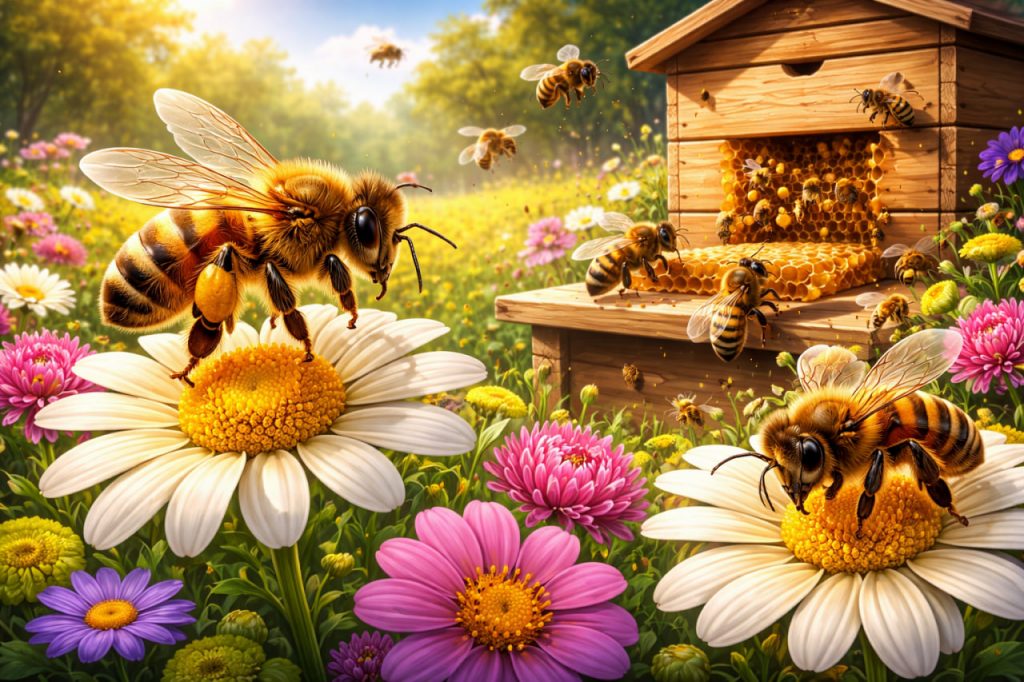
Bees are among the most important organisms in the natural world. Despite their small size, they play a crucial role in maintaining ecosystems and supporting global food production. Bees are best known for producing honey, but their most significant contribution is pollination, the process that allows plants to reproduce. Without bees and other pollinators, many crops and wild plants would struggle to survive, making bees essential for both nature and human life.
What Bees Do in Nature
Bees collect nectar and pollen from flowers as a source of food. While moving from plant to plant, they transfer pollen, enabling fertilization. This process supports the growth of fruits, vegetables, nuts, and seeds. As scientists note:
“Pollinators such as bees are essential for the reproduction of a large proportion of flowering plants.”
This means that bees directly influence biodiversity and agricultural productivity.
Types of Bees
There are thousands of bee species around the world, each with unique behaviors and habitats. The most well-known are honeybees, which live in highly organized colonies. Other types include bumblebees, known for their large size and fuzzy appearance, and solitary bees, which do not form colonies. Each type contributes to pollination in different ways.
Life Inside the Hive
Honeybee colonies are structured societies with clearly defined roles. A typical hive includes a queen bee, worker bees, and drones. The queen is responsible for laying eggs, while worker bees gather food, care for larvae, and maintain the hive. Drones primarily exist to mate with the queen. This division of labor allows the colony to function efficiently.
Honey Production
Bees produce honey by collecting nectar and transforming it through enzymatic processes. The nectar is stored in honeycombs, where it thickens into honey over time. Honey serves as a food source for the colony, especially during colder seasons when flowers are scarce.
Challenges Facing Bees
Bee populations in many parts of the world face significant challenges. Factors such as habitat loss, pesticide use, climate change, and disease can affect their survival. Scientists continue to study these issues to better understand how to protect pollinator populations.
Why Bees Matter for Humans
A large portion of the food consumed by humans depends on pollination. Fruits, vegetables, and many crops rely on bees to reproduce successfully. Protecting bee populations helps ensure food security and supports healthy ecosystems.
A Small Insect With Global Impact
Bees demonstrate how even the smallest creatures can have a massive influence on the planet. Their work supports plant life, food systems, and biodiversity. Understanding their role helps highlight the importance of preserving natural ecosystems for future generations.
P.S. Some say that the mass death of bees in recent years is related to the increasing amount of micro and nano plastics, but this is still being investigated. However, it is a fact that this is the plague of the 21st century…
Interesting Facts
- Bees are responsible for pollinating many global food crops.
- A single bee can visit hundreds of flowers in one day.
- Honey never spoils under proper conditions.
- There are thousands of bee species worldwide.
- Bees communicate using movement patterns often called dances.
Glossary
- Pollination — the transfer of pollen that enables plants to reproduce.
- Hive — a structure where honeybees live and organize their colony.
- Nectar — a sweet liquid produced by flowers.
- Colony — a group of bees living and working together.
- Biodiversity — the variety of living organisms in an ecosystem.