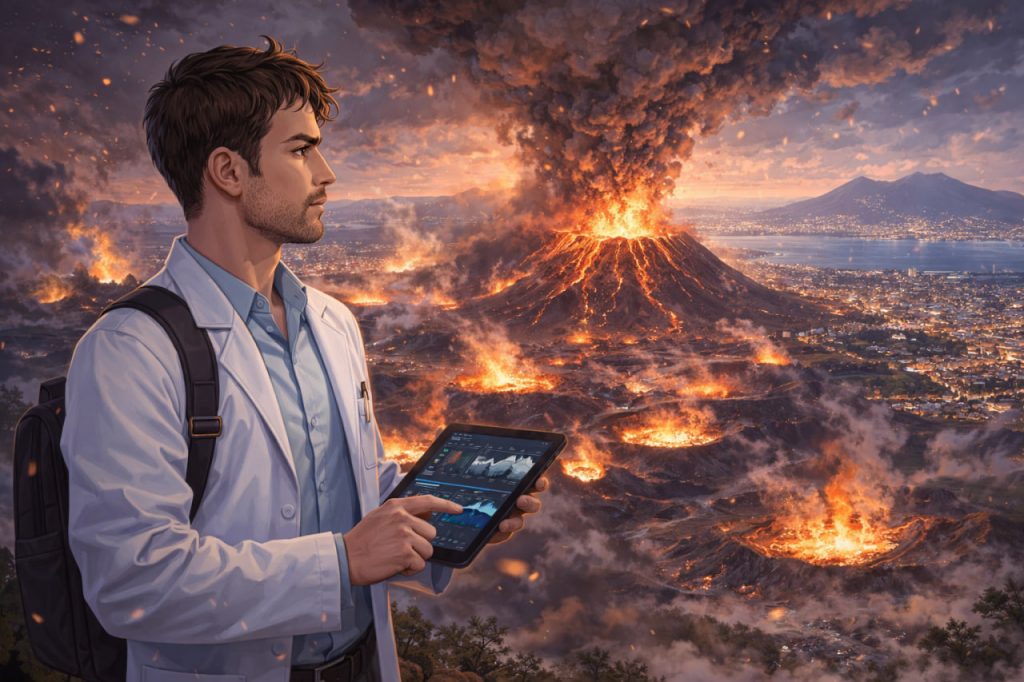
Campi Flegrei, also known as the Phlegraean Fields, is one of the most fascinating and potentially dangerous volcanic systems in the world. Located near Naples in Italy, this vast volcanic area is not a single mountain but a large caldera formed by massive ancient eruptions. Despite its calm appearance today, Campi Flegrei remains an active geological system that scientists monitor closely.
What Makes Campi Flegrei a Supervolcano
Unlike typical volcanoes, Campi Flegrei is classified as a supervolcano, meaning it is capable of extremely large eruptions that can have global consequences. Instead of a single peak, it consists of a wide depression with multiple craters, vents, and geothermal features spread across the region.
As researchers note:
“Supervolcanoes like Campi Flegrei can produce eruptions far more powerful than typical volcanic events.”
This makes it one of the most important volcanic systems to study.
Geological Formation
Campi Flegrei was formed through a series of massive eruptions tens of thousands of years ago. The most significant event created a large caldera after the ground collapsed following the release of huge amounts of magma. Over time, smaller eruptions and geological activity have continued to reshape the area.
The region lies in a tectonically active zone, where interactions between Earth’s crust and underlying magma contribute to ongoing changes.
Current Activity and Monitoring
Although there has not been a major eruption in modern times, Campi Flegrei is far from inactive. Scientists observe ground uplift, gas emissions, and seismic activity, all of which indicate movement beneath the surface.
One notable phenomenon is bradyseism, a gradual rising and sinking of the ground caused by changes in pressure within the volcanic system. This has been observed multiple times and is a key indicator of underground activity.
Potential Risks
An eruption at Campi Flegrei could have significant regional and even global effects. Ash clouds, gas emissions, and climate impacts are among the possible consequences. The proximity of the volcano to densely populated areas increases the importance of continuous monitoring and preparedness.
However, predicting such events remains complex, as volcanic systems can behave unpredictably.
Life Around the Volcano
Despite the risks, the region around Campi Flegrei is home to hundreds of thousands of people. The area is rich in history, culture, and natural beauty. It includes hot springs, fumaroles, and unique landscapes shaped by volcanic activity.
Scientific Importance
Campi Flegrei provides valuable insights into how supervolcanoes function. Studying it helps scientists better understand magma dynamics, eruption triggers, and risk management. This knowledge is essential for improving monitoring systems worldwide.
A Hidden Giant Beneath the Surface
Unlike towering volcanoes, Campi Flegrei does not dominate the skyline. Its power lies beneath the surface, making it both less visible and more complex. It serves as a reminder that some of the most powerful forces on Earth are not always immediately obvious.
Interesting Facts
- Campi Flegrei is a large volcanic caldera, not a single mountain.
- It is located near Naples, Italy.
- The area shows ground movement called bradyseism.
- It contains many craters and geothermal features.
- It is considered one of the most studied supervolcanoes in the world.
Glossary
- Supervolcano — a volcano capable of extremely large eruptions.
- Caldera — a large depression formed after a volcanic collapse.
- Magma — molten rock beneath Earth’s surface.
- Bradyseism — slow rising and sinking of the ground.
- Fumarole — an opening that releases volcanic gases.