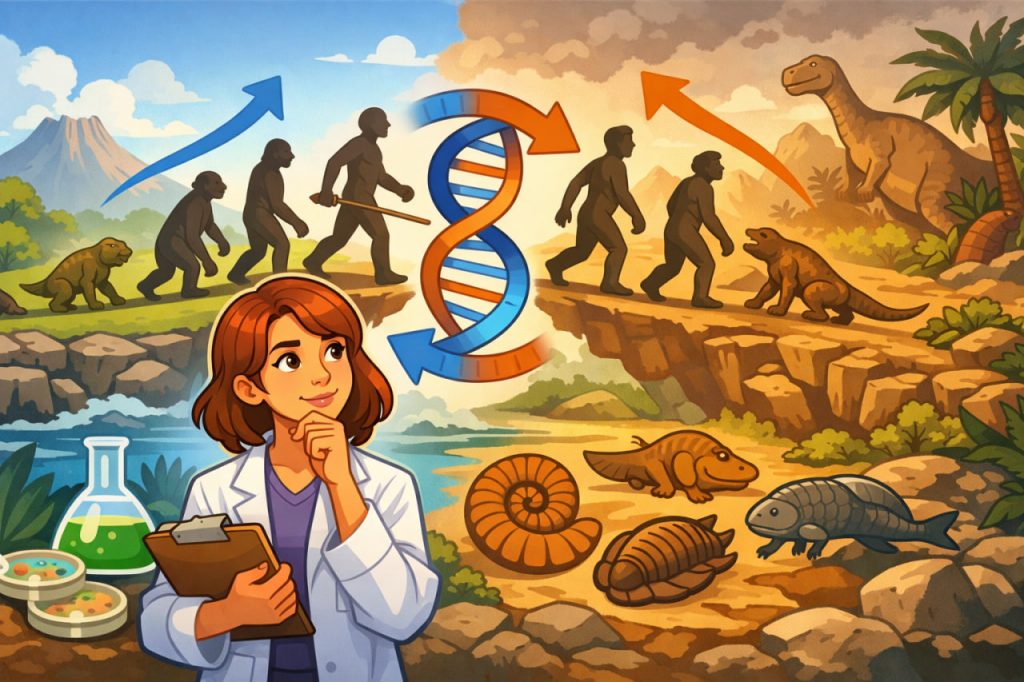
Evolution is often imagined as a one-way process, a steady progression from simple to complex life forms over millions of years. However, the idea of “reverse evolution” raises a fascinating question: can organisms return to earlier forms or undo evolutionary changes? While evolution does not have a goal or direction, it is driven by environmental pressures, genetic variation, and natural selection. This means that under certain conditions, species can develop traits that resemble those of their ancestors. Yet, this does not mean evolution is truly reversible. Instead, it follows complex pathways shaped by history, constraints, and chance. Understanding whether evolution can be “rewound” helps scientists explore the limits of biology, adaptation, and genetic flexibility.
What Does “Reverse Evolution” Really Mean?
The term reverse evolution can be misleading, because evolution does not work like a rewind button. Instead, scientists use the concept of evolutionary reversal to describe situations where organisms regain traits that resemble ancestral characteristics. These changes occur not because evolution moves backward, but because similar environmental pressures can favor similar adaptations. For example, certain cave-dwelling animals lose their eyesight over time, but in rare cases, species exposed again to light may redevelop visual capabilities. According to evolutionary biologist Dr. Marcus Levin:
“Evolution does not remember the past—it reshapes the present.
What looks like reversal is often a new solution that resembles an old one.”
This highlights that apparent reversals are actually new evolutionary outcomes rather than true returns to previous states.
Genetic Constraints and Irreversibility
One of the biggest challenges to reversing evolution lies in genetic constraints. Over time, organisms accumulate mutations, lose genes, or repurpose biological structures for new functions. This makes it extremely difficult to restore an exact previous state. A well-known concept called Dollo’s Law suggests that complex traits, once lost, are unlikely to re-evolve in the exact same form. While exceptions exist, they are rare and usually involve partial or approximate recoveries rather than full reversals. Genetic pathways are often altered in ways that make “going back” biologically inefficient or even impossible. As a result, evolution tends to move forward along new paths instead of retracing old ones.
Experimental Evolution and Laboratory Insights
Modern science allows researchers to study evolution in real time through experimental evolution, particularly with microorganisms like bacteria. In controlled environments, scientists can observe how species adapt to changing conditions and even test whether traits can reappear when conditions are reversed. Some experiments have shown that bacteria can regain previous abilities, such as metabolizing certain nutrients, but often through different genetic mechanisms than before. This demonstrates that while outcomes may look similar, the underlying biology is not identical. These findings support the idea that evolution is repeatable in outcome but not in process, reinforcing the complexity of reversing biological change.
Examples in Nature
There are intriguing examples in nature that appear to support reverse evolution. Some lizards have re-evolved egg-laying after giving birth to live young, and certain insects have regained lost wings. However, closer examination reveals that these traits often persist in a reduced or dormant form within the genome, making their reappearance less of a true reversal and more of a reactivation. In other cases, similar traits evolve independently in different species through convergent evolution, where unrelated organisms develop comparable features due to similar environmental pressures. These examples show that evolution can produce familiar patterns, but rarely retraces its exact steps.
Can Evolution Ever Be Fully Reversed?
In theory, reversing evolution completely would require recreating the exact genetic, environmental, and historical conditions that originally shaped a species. In practice, this is nearly impossible. Evolution is influenced by countless variables, including random mutations and unpredictable environmental changes. Even if similar conditions are recreated, the outcome is likely to differ due to the accumulated changes in genetic material. Scientists conclude that while evolution can sometimes approximate past forms, it cannot truly rewind to a previous state. Instead, life continues to adapt in new and unexpected ways, constantly reshaping itself in response to changing environments.
Interesting Facts
- Some bacteria can re-evolve lost abilities within weeks, but through completely new genetic pathways.
- The concept of irreversibility in evolution is known as Dollo’s Law, proposed in the 19th century.
- Cave animals often lose vision, but some retain hidden genetic pathways related to eyesight.
- Evolution can repeat similar outcomes in different species, a process called convergent evolution.
- Even when traits reappear, they are rarely identical to their original ancestral forms.
Glossary
- Reverse Evolution — the idea that organisms can return to ancestral traits, though usually only approximately.
- Dollo’s Law — the principle that complex traits lost in evolution are unlikely to reappear in the same form.
- Convergent Evolution — the independent development of similar traits in unrelated species.
- Genetic Constraint — limitations on evolution caused by existing genetic structures and history.
- Experimental Evolution — the study of evolutionary processes in controlled laboratory conditions.