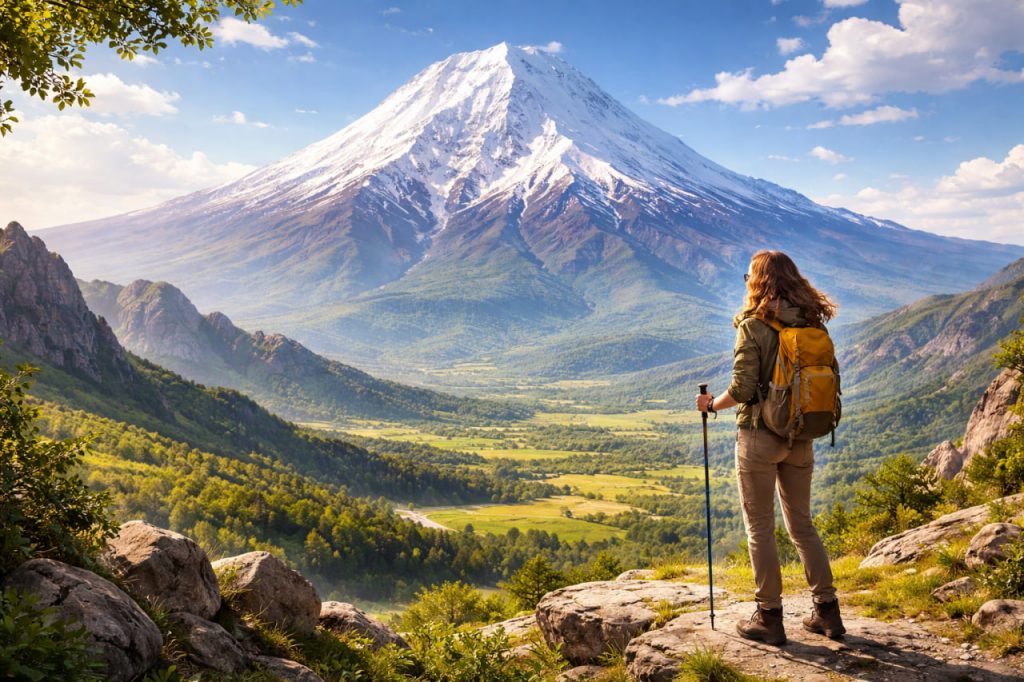
Mount Ararat is one of the most recognizable and symbolically significant mountains in the world. Located in eastern Turkey near the borders of Armenia and Iran, it rises dramatically above the surrounding plains, creating a striking and isolated landscape. With its snow-covered summit, volcanic origin, and deep cultural meaning, Ararat stands as a powerful intersection of geology, history, and mythology. For centuries, it has inspired explorers, scientists, and storytellers alike.
Geological Origin and Structure
Mount Ararat is a stratovolcano, formed over time by layers of lava, ash, and volcanic debris. It consists of two main peaks: Greater Ararat, which reaches approximately 5,137 meters, and Lesser Ararat, a smaller but still prominent cone nearby. The mountain was shaped by tectonic activity in a region where major geological plates interact, creating pressure that allowed magma to rise and form the volcanic structure.
Although Ararat is considered dormant, it is not extinct. Evidence of past eruptions suggests that the mountain still has the potential for activity. As researchers note:
“Stratovolcanoes like Ararat are formed through repeated eruptions and can remain dormant for long periods.”
This makes it an important subject for geological study.
Climate and Glacial Features
Despite being located in a relatively dry region, Mount Ararat maintains permanent ice and glaciers at higher elevations. These glaciers form due to low temperatures at altitude and play a key role in the mountain’s ecosystem. Over time, scientists have observed gradual changes in glacial size, which are often studied in relation to broader environmental patterns.
The mountain creates its own microclimate, where conditions at the base differ significantly from those near the summit. This variation contributes to the diversity of landscapes found on its slopes.
Cultural and Historical Importance
Mount Ararat holds deep cultural significance, especially for Armenian heritage. Although it lies within modern Turkish territory, it remains a powerful national symbol of Armenia and appears in art, literature, and historical identity. The mountain has been referenced in texts and traditions for thousands of years, reinforcing its importance beyond geography.
The Legend of Noah’s Ark
One of the most famous associations with Mount Ararat is the story of Noah’s Ark, which, according to tradition, came to rest on the mountain after a great flood. This legend has inspired numerous expeditions and scientific investigations aimed at finding physical evidence.
While no verified discoveries have confirmed the presence of the ark, the story continues to attract attention and adds to the mountain’s mystique.
Scientific Research and Exploration
Modern technology has allowed scientists to study Mount Ararat more closely. Satellite imagery, geological surveys, and climate monitoring provide insights into its structure and changes over time. Some unusual formations observed on the mountain have sparked debate, though most are explained through natural geological processes.
Research in this region remains challenging due to its remote location and environmental conditions, but it continues to provide valuable data.
Climbing and Human Interaction
Mount Ararat is a popular destination for climbers seeking both adventure and achievement. While the climb does not require advanced technical skills, it demands physical endurance, preparation, and adaptation to altitude. Reaching the summit offers expansive views and a unique experience of one of the world’s most iconic peaks.
A Mountain of Science and Myth
Mount Ararat represents a rare combination of natural power and cultural meaning. It is a geological structure shaped by Earth’s internal forces, yet also a symbol deeply embedded in human history and belief. This dual identity makes Ararat not just a mountain, but a lasting reminder of how nature and storytelling are often intertwined.
Interesting Facts
- Mount Ararat is the highest mountain in Turkey.
- It consists of two volcanic peaks: Greater and Lesser Ararat.
- The mountain is linked to the legend of Noah’s Ark.
- It contains permanent glaciers despite a dry climate.
- Ararat is a key symbol in Armenian culture.
Glossary
- Stratovolcano — a volcano built from layers of lava and ash.
- Dormant Volcano — a volcano that is inactive but may erupt again.
- Glacier — a large mass of slowly moving ice.
- Tectonic Plates — sections of Earth’s crust that move over time.
- Summit — the highest point of a mountain.