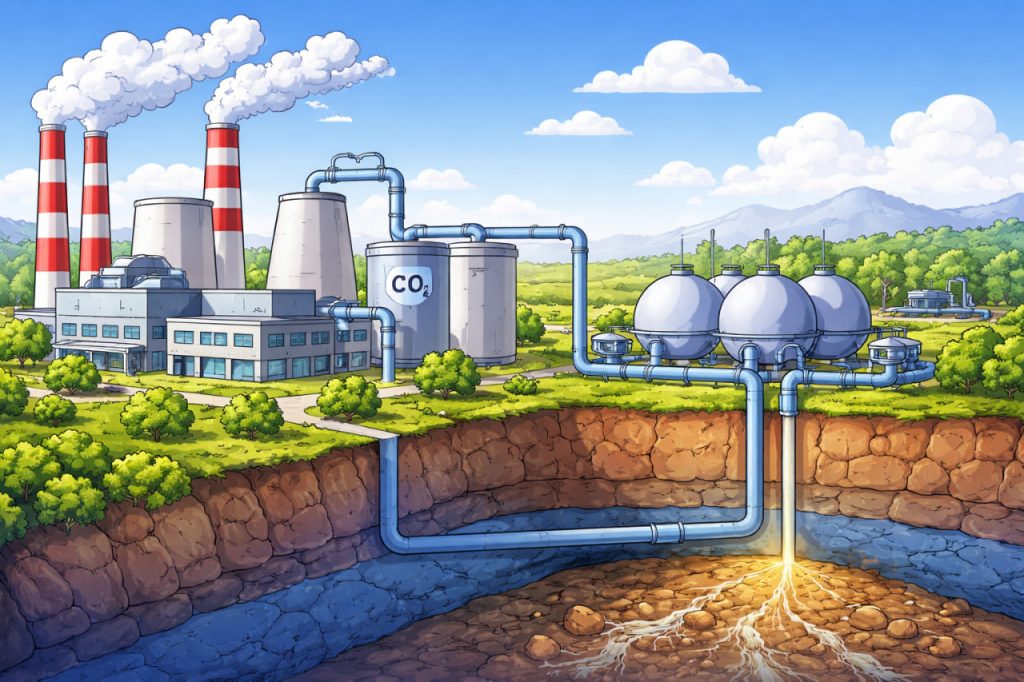
Carbon capture and storage (CCS) is a technology designed to reduce carbon dioxide emissions from industrial sources such as power plants. As concerns about climate change grow, CCS is increasingly seen as a potential solution for reducing emissions without completely replacing existing energy infrastructure. Instead of releasing CO₂ into the atmosphere, these systems capture it at the source, transport it, and store it deep underground. This approach allows traditional power plants, including coal and gas facilities, to operate with a significantly lower environmental impact. However, questions remain about cost, scalability, and long-term effectiveness. Understanding CCS is essential for evaluating whether it can truly help “green” existing power generation systems.
How Carbon Capture and Storage Works
CCS involves three main stages: capture, transport, and storage. First, CO₂ is separated from other gases produced during combustion or industrial processes. This can be done using chemical solvents, membranes, or advanced filtration technologies. Once captured, the carbon dioxide is compressed and transported—usually via pipelines—to storage sites. These sites are typically deep geological formations such as depleted oil and gas fields or saline aquifers. According to energy systems expert Dr. Laura Simmons:
“Carbon capture is not about eliminating emissions entirely,
but about managing them in a way that reduces their impact on the atmosphere.”
This highlights CCS as a mitigation tool rather than a complete solution.
Can CCS Reduce Power Plant Emissions?
CCS has the potential to capture up to 90% of CO₂ emissions from power plants under optimal conditions. This makes it one of the most effective technologies for reducing emissions from existing infrastructure. By integrating CCS, thermal power plants can continue operating while significantly lowering their carbon footprint. This is particularly important for regions that still rely heavily on fossil fuels for energy production. However, the effectiveness of CCS depends on proper implementation, maintenance, and monitoring.
Challenges and Limitations
Despite its promise, CCS faces several challenges. One major issue is high cost, as capturing and storing carbon requires additional energy and infrastructure. This can reduce the overall efficiency of power plants. There are also concerns about the long-term safety of storage sites, including the risk of CO₂ leakage. Additionally, CCS does not address other environmental impacts of fossil fuel use, such as air pollution or resource extraction. These limitations mean that CCS is often viewed as a transitional solution rather than a permanent fix.
Role in the Energy Transition
CCS can play an important role in the transition to cleaner energy systems, especially in sectors where emissions are difficult to eliminate. It can be combined with renewable energy or used in industries such as cement and steel production. Some approaches, such as carbon capture with utilization (CCU), aim to reuse captured CO₂ in products like fuels or building materials. This expands the potential applications of carbon management technologies and supports a more circular approach to emissions.
Can CCS Truly “Green” Power Plants?
While CCS can significantly reduce emissions, it does not make fossil fuel power plants completely environmentally neutral. It is best understood as a partial solution that can help bridge the gap between current energy systems and a low-carbon future. Long-term sustainability will likely require a combination of renewable energy, efficiency improvements, and carbon management technologies. CCS can contribute to this transition, but it is not a standalone answer to climate change.
Interesting Facts
- CCS can capture up to 90% of CO₂ emissions from certain power plants.
- Some storage sites can hold carbon dioxide for thousands of years.
- Captured CO₂ can be reused in industrial processes and materials.
- CCS is already used in some oil and gas operations worldwide.
- The technology can be applied beyond energy, including in heavy industry.
Glossary
- Carbon Capture and Storage (CCS) — technology for capturing and storing CO₂ emissions.
- CO₂ (Carbon Dioxide) — a greenhouse gas contributing to climate change.
- Geological Storage — storing substances deep underground in rock formations.
- CCU (Carbon Capture and Utilization) — using captured CO₂ in industrial applications.
- Emissions — gases released into the atmosphere from various processes.