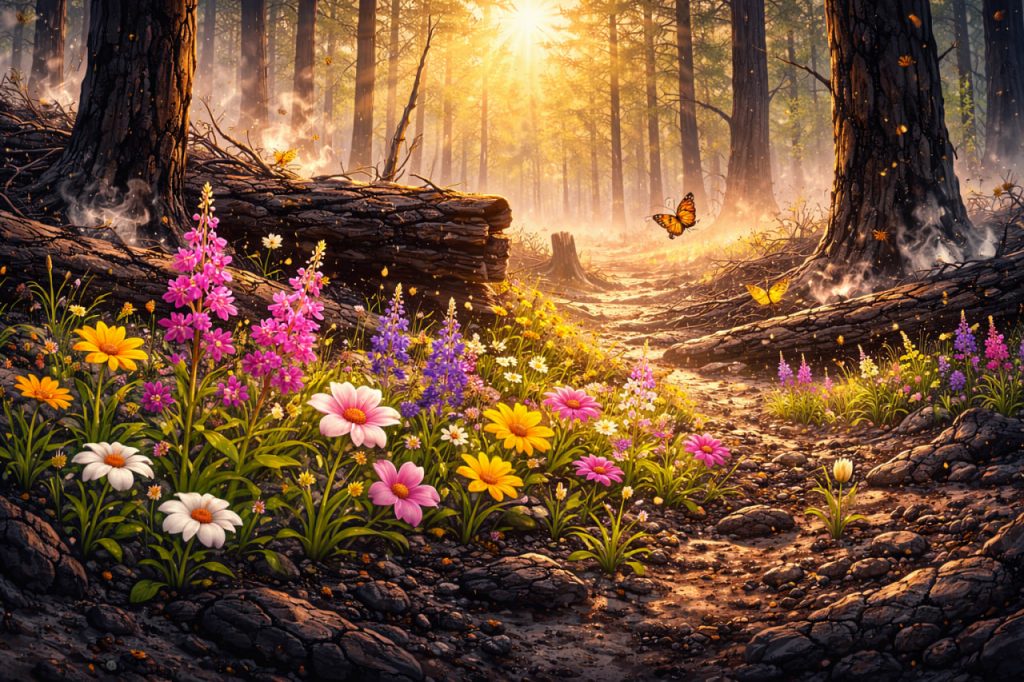
After a forest fire, the landscape may appear lifeless and destroyed, yet within a surprisingly short time, bright flowers begin to emerge from the ash-covered ground. This phenomenon is not random but a result of evolutionary adaptation. Many plant species have developed mechanisms that allow them to survive fires and even depend on them for growth. Fire clears competition, enriches the soil, and creates ideal conditions for certain plants to thrive. These early bloomers play a crucial role in restoring ecosystems and initiating the process of recovery. Understanding this process reveals how nature transforms destruction into renewal.
Fire as a Natural Reset
Wildfires act as a natural reset mechanism in many ecosystems. They remove dense vegetation, allowing sunlight to reach the ground and creating space for new growth. The ash left behind is rich in minerals, providing nutrients that support plant development. According to ecologist Dr. Laura Bennett:
“Fire may look destructive, but it creates the perfect conditions
for new life to begin almost immediately.”
This combination of light, space, and nutrients gives flowers a strong advantage.
Seeds That Wait for Fire
Some plants produce seeds that remain dormant in the soil for years, waiting for the right conditions to germinate. Heat from a fire can break the hard outer coating of seeds, triggering their growth. In other cases, chemicals in smoke act as signals that stimulate germination. These adaptations ensure that certain flowers appear quickly after a fire.
Reduced Competition
After a fire, many large plants and trees are temporarily gone, reducing competition for light, water, and nutrients. This allows fast-growing flowers to establish themselves before other vegetation returns. These early plants are often called pioneer species, as they are the first to colonize disturbed environments.
Role in Ecosystem Recovery
Flowers that grow after fires are not just visually striking—they play a key role in ecosystem recovery. They attract pollinators such as bees and butterflies, helping restore biological activity. Their roots stabilize the soil, preventing erosion, while their growth contributes to rebuilding the food chain.
A Cycle of Renewal
In many ecosystems, fire is part of a natural cycle. Plants that depend on fire have evolved alongside it, creating a system where destruction leads to renewal. Over time, grasses, shrubs, and eventually trees return, but flowers are often the first visible sign that life is coming back.
Interesting Facts
- Some seeds only germinate after exposure to fire or smoke.
- Ash can act as a natural fertilizer for plants.
- Certain flowers can appear within days or weeks after a fire.
- Fire-dependent ecosystems exist in many parts of the world.
- These early plants help attract pollinators back to the area.
Glossary
- Pioneer Species — the first organisms to grow in a disturbed area.
- Germination — the process by which a seed begins to grow.
- Ecosystem Recovery — the restoration of a damaged environment.
- Dormancy — a state in which seeds remain inactive until conditions are right.
- Pollinators — organisms that help plants reproduce by transferring pollen.