Carbon dioxide (CO₂) is a natural part of Earth’s atmosphere, playing a key role in maintaining the planet’s temperature. However, without natural systems that absorb and recycle CO₂, life as we know it would not exist. Nature has developed powerful mechanisms that continuously remove carbon dioxide from the atmosphere and convert it into oxygen, biomass, and stored carbon. These processes form the foundation of Earth’s climate stability and support nearly all ecosystems. Understanding how CO₂ is processed in nature reveals the delicate balance that keeps our planet habitable.
Photosynthesis: The Primary Engine of Life
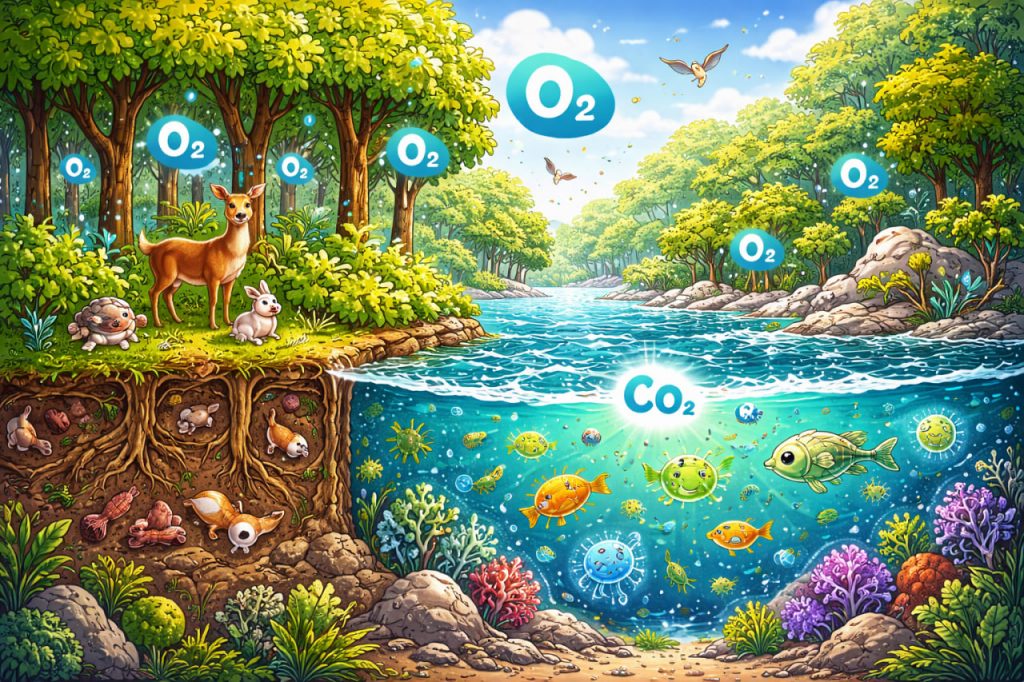
The most important process that removes carbon dioxide from the atmosphere is photosynthesis. This process is carried out by plants, algae, and certain bacteria, which use sunlight to convert CO₂ and water into glucose (energy) and oxygen.
“Photosynthesis is the engine of life on Earth,
transforming carbon dioxide into the building blocks of ecosystems.”
Through this process, forests, grasslands, and oceans continuously absorb carbon dioxide while releasing oxygen, making life possible.
Key Players in Photosynthesis
- Trees and plants — absorb CO₂ from the air and store carbon in their tissues
- Phytoplankton — microscopic ocean organisms responsible for a huge share of global oxygen production
- Algae — contribute significantly in aquatic environments
Together, these organisms form the largest natural system for carbon regulation on Earth.
Oceans: The Planet’s Largest Carbon Sink
Oceans absorb a significant portion of atmospheric CO₂, acting as a massive carbon reservoir. Carbon dioxide dissolves in seawater and is used by marine organisms or stored in chemical forms.
How Oceans Store Carbon
- CO₂ dissolves directly into water
- Marine organisms use it to build shells (calcium carbonate)
- Carbon sinks to the ocean floor when organisms die
This process helps regulate global temperatures and slows climate change.
Soil and Microorganisms: Hidden Carbon Managers
Soil is one of the most underestimated systems in the carbon cycle. It stores more carbon than the atmosphere and vegetation combined. Microorganisms such as bacteria and fungi play a key role in breaking down organic matter and recycling carbon.
What Happens in Soil
- Dead plants and animals decompose
- Carbon is stored in organic matter
- Some carbon is released back as CO₂
Healthy soils are essential for maintaining a balanced carbon cycle.
Forests: Carbon Storage Giants
Forests act as long-term carbon storage systems, absorbing CO₂ and locking it into wood, leaves, and roots. Large forests like tropical rainforests are especially important because they store vast amounts of carbon over long periods.
Deforestation disrupts this balance, releasing stored carbon back into the atmosphere and reducing the planet’s ability to absorb CO₂.
The Carbon Cycle: A Continuous Loop
All these processes—photosynthesis, ocean absorption, and soil activity—are part of the carbon cycle, a continuous movement of carbon through the atmosphere, living organisms, and Earth’s systems.
This cycle ensures that carbon is constantly reused rather than accumulating in one place. When balanced, it helps maintain a stable climate. When disrupted, it can lead to climate change and environmental instability.
Why It Matters
Natural systems that process carbon dioxide are essential for:
- Maintaining breathable air
- Regulating Earth’s temperature
- Supporting ecosystems and food chains
- Stabilizing the global climate
Protecting forests, oceans, and soils is critical for preserving these natural processes.
Interesting Facts
- Phytoplankton produce about half of Earth’s oxygen.
- Oceans absorb around 25–30% of human CO₂ emissions.
- Soil stores more carbon than plants and atmosphere combined.
- A single large tree can absorb tens of kilograms of CO₂ per year.
- Carbon can remain stored in forests for hundreds of years.
Glossary
- Carbon Dioxide (CO₂) — a gas in the atmosphere involved in the carbon cycle.
- Photosynthesis — the process of converting CO₂ into energy using sunlight.
- Carbon Cycle — the movement of carbon through Earth’s systems.
- Carbon Sink — a system that absorbs more carbon than it releases.
- Phytoplankton — microscopic ocean organisms that perform photosynthesis.