Modern civilization produces enormous amounts of waste every day. Cities generate mountains of garbage consisting of food scraps, plastics, paper, organic waste, and discarded materials from millions of households. Traditionally, much of this waste ended up in landfills, creating environmental pollution and releasing greenhouse gases into the atmosphere.
However, scientists and engineers increasingly view waste not only as a problem, but also as a potential energy resource. Technologies capable of converting household garbage into electricity, heat, or fuel are rapidly developing worldwide. This approach is often called waste-to-energy (WtE) technology.
Supporters believe energy from waste could help reduce landfill use, lower fossil fuel dependence, and improve urban sustainability. Critics warn about pollution risks, economic costs, and the importance of recycling. As global waste production continues rising, the debate surrounding waste-based energy is becoming increasingly important.
What Is Waste-to-Energy?
Waste-to-energy refers to technologies that convert municipal solid waste into usable energy.
This may include:
- Electricity
- Heat
- Biogas
- Synthetic fuels
Instead of simply burying garbage underground, waste-to-energy systems extract useful energy from materials that would otherwise be discarded.
Modern WtE systems often process:
- Household trash
- Food waste
- Paper products
- Organic materials
- Certain plastics
The goal is to reduce waste volume while recovering energy.
Why Waste Became an Energy Problem
Modern cities produce enormous amounts of waste daily.
Landfills create several environmental concerns:
- Methane emissions
- Soil contamination
- Groundwater pollution
- Land usage problems
Methane is a particularly powerful greenhouse gas produced during decomposition of organic waste.
As urban populations grow, managing waste safely becomes increasingly difficult.
This encouraged scientists to search for methods turning waste into a resource rather than merely a disposal problem.
How Waste-to-Energy Plants Work
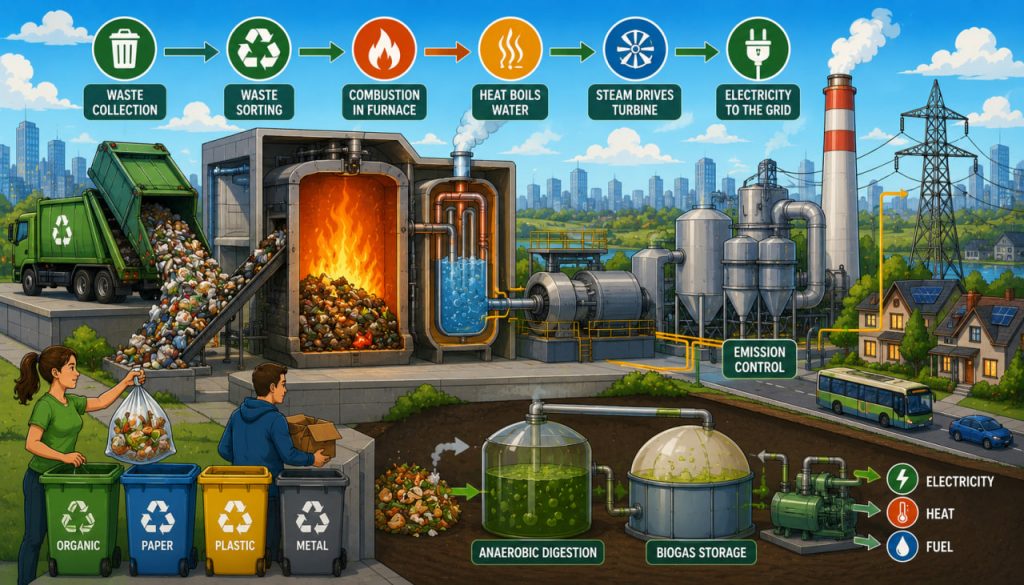
The most common waste-to-energy method involves controlled combustion.
Garbage is burned in specialized facilities at high temperatures.
The heat generated produces steam, which drives turbines to generate electricity.
Modern plants often include advanced filtration systems designed to reduce:
- Toxic emissions
- Particulate pollution
- Harmful gases
Energy engineer Professor Nickolas Themelis explained:
“Waste-to-energy provides a practical method of reducing landfill dependence while recovering useful energy.”
This combination of waste reduction and power generation makes WtE attractive for densely populated cities.
Biogas from Organic Waste
Not all waste-to-energy systems rely on burning.
Organic waste such as:
- Food scraps
- Agricultural waste
- Sewage sludge
can produce biogas through anaerobic digestion.
In this process:
- Microorganisms break down organic matter without oxygen
- Methane-rich gas is produced
- The gas can then generate electricity or heat
Biogas systems are considered especially useful for organic waste management.
Plasma Gasification and Advanced Technologies
Some advanced technologies attempt to process waste more efficiently.
One example is plasma gasification, which uses extremely high temperatures to break waste into:
- Synthetic gas (syngas)
- Reusable materials
These methods remain expensive but may offer cleaner alternatives in the future.
Scientists continue researching ways to improve efficiency and reduce emissions.
Environmental Benefits
Waste-to-energy systems may provide several advantages.
Potential benefits include:
- Reduced landfill use
- Lower methane emissions
- Energy recovery from waste
- Reduced fossil fuel consumption
Some countries with limited land area strongly support WtE because landfills occupy valuable space.
Waste-to-energy may also complement recycling and renewable energy systems in urban environments.
Criticism and Environmental Concerns
Despite its advantages, waste-to-energy remains controversial.
Critics raise concerns about:
- Air pollution
- Carbon emissions
- Toxic ash byproducts
- Reduced recycling incentives
Improperly managed facilities may release harmful pollutants.
Environmental organizations often argue that:
- Waste reduction
- Reuse
- Recycling
should remain the primary priority before energy recovery.
Modern systems therefore require strict environmental controls.
Waste Hierarchy: Energy vs Recycling
Most experts support a “waste hierarchy” approach.
This hierarchy generally prioritizes:
- Reducing waste generation
- Reusing materials
- Recycling
- Energy recovery
- Landfill disposal
Waste-to-energy is usually considered preferable to landfilling but less ideal than recycling whenever recycling is practical.
The best systems often combine multiple approaches.
Countries Using Waste-to-Energy
Several countries already rely heavily on WtE systems.
Examples include:
- Sweden
- Japan
- Denmark
- Germany
Some nations even import waste for energy generation because their facilities are highly efficient.
These countries typically combine:
- Recycling programs
- Strict emissions regulation
- Advanced waste sorting systems
to improve sustainability.
Can Household Waste Replace Fossil Fuels?
Most experts believe waste alone cannot fully replace traditional energy sources.
However, waste-to-energy may become an important supplementary energy system, especially in large urban areas.
Future cities may increasingly integrate:
- Recycling infrastructure
- Biogas production
- Smart waste management
- Energy recovery systems
to create more circular economies.
Artificial Intelligence and Smart Waste Systems
Modern AI technologies are improving waste management rapidly.
Artificial intelligence now helps:
- Sort recyclable materials
- Optimize waste collection routes
- Monitor emissions
- Improve plant efficiency
Automation may significantly improve future waste processing systems.
The Future of Waste-Based Energy
Future innovations may involve:
- Cleaner combustion systems
- Better filtration technologies
- Improved recycling integration
- Advanced biogas production
- AI-controlled waste facilities
As global waste production continues increasing, energy recovery technologies may become increasingly important.
Why This Technology Matters
Human civilization produces enormous waste volumes every year.
Turning at least part of this waste into useful energy may help:
- Reduce environmental damage
- Improve urban sustainability
- Lower landfill dependence
- Recover valuable resources
Although not a perfect solution, waste-to-energy technology demonstrates how modern engineering increasingly transforms problems into opportunities.
Interesting Facts
- Some countries generate electricity for entire cities using waste-to-energy systems.
- Organic waste naturally produces methane during decomposition.
- Modern waste-to-energy plants use advanced emission filters.
- Sweden imports some waste for energy generation.
- AI systems increasingly assist modern recycling and waste sorting.
Glossary
- Waste-to-Energy (WtE) — Technology converting waste materials into usable energy.
- Biogas — Methane-rich gas produced by decomposition of organic matter.
- Landfill — A site used for long-term waste disposal.
- Anaerobic Digestion — Breakdown of organic material without oxygen.
- Methane — A powerful greenhouse gas produced during decomposition.