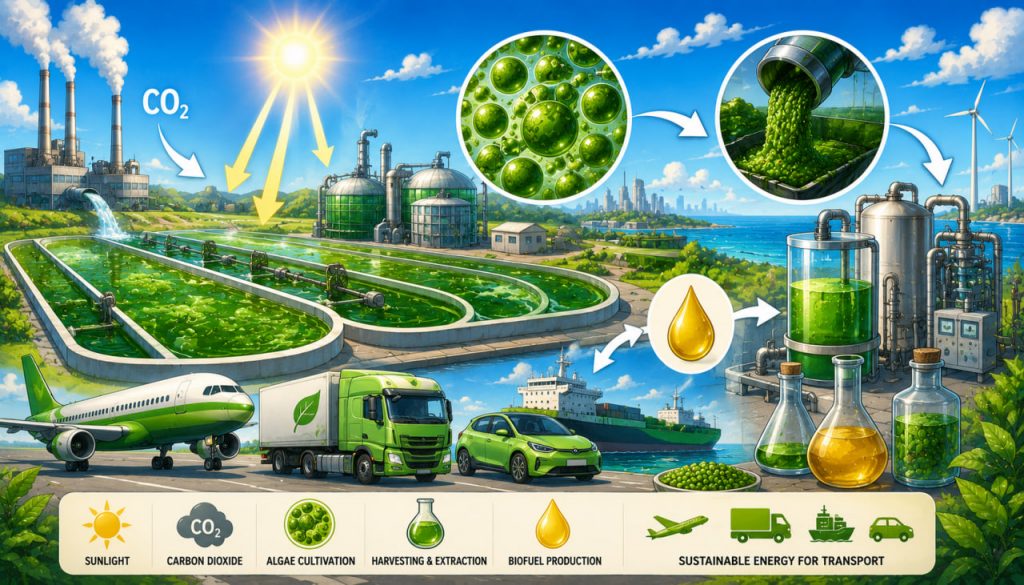
For decades, scientists and futurists dreamed about creating clean fuel from microscopic algae. What once sounded like science fiction is now becoming an increasingly realistic technology with the potential to transform global energy systems. Algae biofuel is attracting attention because it may provide renewable energy without some of the major environmental problems associated with fossil fuels and traditional biofuels.
Unlike oil drilling or coal mining, algae can grow rapidly using sunlight, water, and carbon dioxide. Some species produce large amounts of oils and organic compounds that can be converted into fuel for cars, airplanes, ships, and industrial systems.
Although major technological and economic challenges still exist, researchers believe algae biofuel could become an important part of the future energy transition.
What Is Algae Biofuel?
Algae biofuel is fuel produced from algae — simple aquatic organisms capable of photosynthesis.
Algae range from:
- Tiny microscopic phytoplankton
- Large seaweeds
- Specialized oil-rich microalgae
Certain algae species naturally produce oils, fats, and carbohydrates that scientists can process into:
- Biodiesel
- Bioethanol
- Biogas
- Sustainable aviation fuel
Because algae grow rapidly, they are considered a renewable biological energy source.
Why Scientists Became Interested in Algae
Traditional fossil fuels create major environmental concerns, including:
- Greenhouse gas emissions
- Air pollution
- Climate change
- Resource depletion
Meanwhile, first-generation biofuels made from crops such as corn or soybeans created additional problems:
- Competition with food production
- Large land use requirements
- Freshwater consumption
Algae appeared attractive because they may avoid some of these limitations.
Unlike many agricultural crops, algae can grow:
- In saltwater
- In wastewater
- On non-arable land
This makes them potentially more sustainable.
How Algae Produce Energy
Like plants, algae use photosynthesis to convert sunlight into chemical energy.
Some algae species store large quantities of:
- Lipids (oils)
- Carbohydrates
- Organic compounds
Scientists harvest this biomass and process it into fuel through chemical or biological methods.
The extracted oils can be refined into biodiesel similar to petroleum-based fuels.
Why Algae Are Considered So Promising
Algae possess several major advantages compared to traditional crops.
Extremely Fast Growth
Certain algae can grow far faster than land plants.
High Oil Yield
Some species produce significantly more oil per area than soybeans or other biofuel crops.
Carbon Dioxide Absorption
Algae absorb CO₂ during growth, potentially helping reduce industrial emissions.
Flexible Cultivation
Algae can grow in:
- Tanks
- Open ponds
- Coastal systems
- Industrial wastewater
This flexibility increases their potential scalability.
Algae and Aviation Fuel
One of the most promising applications involves aviation.
Airplanes are difficult to electrify because batteries remain too heavy for long-distance commercial flights.
As a result, scientists are searching for sustainable liquid fuels.
Several companies and research groups already tested algae-based aviation fuel successfully.
Environmental engineer Dr. Stephen Mayfield stated:
“Algae may provide one of the few renewable solutions capable of replacing petroleum-based jet fuel at scale.”
This possibility makes algae especially important for future transportation.
Challenges Preventing Mass Adoption
Despite its promise, algae biofuel still faces major obstacles.
High Production Costs
Growing, harvesting, and processing algae remains expensive.
Energy Efficiency Problems
Some production systems consume large amounts of energy themselves.
Technical Complexity
Maintaining optimal algae growth conditions requires careful control of:
- Light
- Temperature
- Nutrients
- Water chemistry
Scaling Difficulties
Laboratory success does not always translate easily into industrial-scale production.
Scientists continue working to solve these issues.
Genetic Engineering and Algae Research
Modern biotechnology is helping improve algae efficiency.
Researchers are experimenting with:
- Genetically modified algae
- Enhanced oil production
- Faster growth rates
- Better environmental tolerance
Artificial intelligence and automation also increasingly assist algae cultivation systems.
Future advances may dramatically improve economic viability.
Environmental Benefits
If developed successfully, algae biofuel could provide several environmental advantages.
Potential benefits include:
- Lower carbon emissions
- Reduced fossil fuel dependence
- Renewable energy production
- Wastewater recycling opportunities
Some algae systems may even capture industrial CO₂ emissions directly from factories or power plants.
This creates potential climate-related applications.
Could Algae Replace Oil Completely?
Most experts believe algae will likely supplement rather than fully replace fossil fuels in the near future.
Global energy demand remains enormous.
However, algae may become especially valuable in sectors difficult to electrify, including:
- Aviation
- Shipping
- Heavy industry
Future energy systems will probably combine:
- Renewable electricity
- Hydrogen
- Nuclear energy
- Advanced biofuels
rather than relying on a single solution.
Algae Beyond Fuel
Interestingly, algae are useful far beyond energy production.
Scientists also use algae in:
- Food supplements
- Pharmaceuticals
- Cosmetics
- Bioplastics
- Animal feed
This versatility makes algae one of the most commercially interesting biological resources currently studied.
The Future of Algae Biofuel
Many governments and private companies continue investing heavily in algae research.
Future improvements in:
- Biotechnology
- Automation
- AI-driven cultivation
- Industrial engineering
could significantly reduce production costs.
If technological breakthroughs continue, algae biofuel may become an important part of global sustainable energy systems during the coming decades.
Why This Technology Matters
The search for cleaner energy sources is one of the biggest scientific and economic challenges of the modern world.
Algae biofuel represents a fascinating example of how biology and technology may work together to create new sustainable solutions.
What once seemed like a futuristic fantasy is gradually moving closer to industrial reality.
Interesting Facts
- Some algae species can double their mass within hours under ideal conditions.
- Algae produce much of the oxygen on Earth through photosynthesis.
- Certain algae can contain very high oil concentrations.
- Scientists are testing algae fuel for commercial aviation.
- Algae can grow using wastewater unsuitable for agriculture.
Glossary
- Biofuel — Fuel produced from biological materials rather than fossil sources.
- Photosynthesis — The process by which organisms convert sunlight into chemical energy.
- Microalgae — Microscopic algae species often used in biotechnology research.
- Biodiesel — A renewable fuel made from biological oils or fats.
- Carbon Dioxide (CO₂) — A greenhouse gas absorbed by plants and algae during photosynthesis.