Humans experience the world through five familiar senses:
- Sight
- Hearing
- Smell
- Taste
- Touch
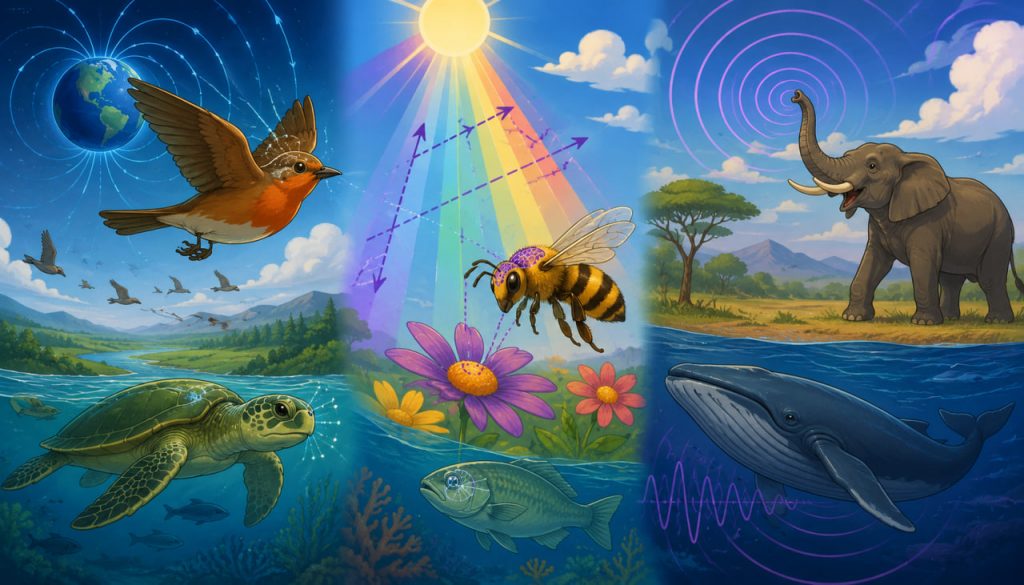
However, many animals possess sensory abilities that seem almost supernatural from a human perspective. These extraordinary capabilities allow them to detect environmental signals that are completely invisible or inaudible to us.
Among the most fascinating animal super senses are the ability to perceive:
- Earth’s magnetic field
- Polarized light
- Infrasound
These hidden channels of information help animals:
- Navigate across continents
- Find food
- Avoid predators
- Predict environmental changes
Modern science continues to uncover remarkable evidence that many species experience a version of reality far richer than our own.
The Hidden Sensory World of Animals
Every species evolves sensory systems suited to its environment.
Humans rely heavily on:
- Vision
- Language
Other animals may depend on:
- Magnetic navigation
- Electrical signals
- Vibrations
- Chemical cues
As scientists develop more advanced tools, they increasingly discover that animals perceive information that humans cannot directly detect.
These abilities are often called:
- Extra senses
- Animal super senses
although they arise from normal biological mechanisms.
Magnetoreception: Detecting Earth’s Magnetic Field
One of the most extraordinary abilities in nature is:
- Magnetoreception
This is the ability to sense Earth’s magnetic field.
Earth functions like a giant magnet with:
- Magnetic poles
- Magnetic field lines
Many animals appear capable of detecting this invisible field and using it as a natural navigation system.
Birds and the Internal Compass
Migratory birds provide some of the strongest evidence for magnetoreception.
Many species travel:
- Thousands of kilometers
- Across oceans
- Through unfamiliar terrain
yet return to remarkably precise locations.
Scientists believe birds combine multiple navigation methods, including:
- The Sun
- The Stars
- Landmarks
- Earth’s magnetic field
This internal compass helps them maintain direction during long migrations.
How Do Birds Sense Magnetism?
Researchers have proposed two main mechanisms.
The first involves:
- Magnetite crystals
Tiny iron-containing particles found in some animal tissues.
The second involves specialized light-sensitive proteins called:
- Cryptochromes
located in the eyes of certain birds.
Some scientists believe birds may actually “see” magnetic-field patterns superimposed on their visual environment.
Although the exact mechanism remains under investigation, evidence strongly supports magnetic sensing in many species.
Other Animals That Use Magnetic Fields
Magnetoreception has been observed or suspected in:
- Sea turtles
- Salmon
- Sharks
- Lobsters
- Bees
- Bats
Sea turtles are particularly impressive.
Young turtles can cross entire ocean basins and later return to nesting beaches with astonishing accuracy.
Their ability likely depends partly on magnetic-field information.
Polarized Light: Seeing Invisible Patterns
Another remarkable sensory ability involves:
- Polarized light
Sunlight becomes partially polarized when it scatters through Earth’s atmosphere.
Humans generally cannot perceive these polarization patterns.
Many animals can.
What Is Polarized Light?
Ordinary light waves vibrate in many directions.
Polarized light vibrates primarily in specific orientations.
The sky contains polarization patterns that change depending on:
- Sun position
- Weather conditions
- Time of day
For animals capable of detecting them, these patterns provide valuable navigational information.
Insects and Polarized Vision
Many insects use polarized light for navigation.
Examples include:
- Bees
- Ants
- Dragonflies
Honeybees can use polarization patterns to determine the Sun’s position even when:
- Clouds partially obscure the sky
This helps them navigate efficiently between:
- Flowers
- The hive
Polarized Light Underwater
Marine animals also benefit from polarized vision.
Water modifies light in complex ways.
Species such as:
- Squid
- Cuttlefish
- Some fish
may use polarization sensitivity for:
- Navigation
- Hunting
- Communication
This provides information unavailable to most predators and prey.
Infrasound: Hearing Below Human Limits
Humans typically hear sounds between approximately:
- 20 Hz and 20,000 Hz
Sounds below 20 Hz are called:
- Infrasound
These low-frequency waves can travel enormous distances.
Many animals can detect them.
Elephants and Long-Distance Communication
Elephants are among the best-known users of infrasound.
They produce low-frequency calls that can travel:
- Several kilometers
through air and ground vibrations.
This allows elephant groups to communicate across vast distances.
Messages may include information about:
- Movement
- Social interactions
- Environmental conditions
Whales and Ocean-Wide Signals
Some whale species also use extremely low-frequency sounds.
These signals can travel through ocean water over extraordinary distances.
In the open ocean, whales may communicate with individuals located:
- Hundreds of kilometers away
making them among the longest-distance communicators in the animal kingdom.
Can Animals Predict Natural Disasters?
There are numerous reports of animals behaving unusually before:
- Earthquakes
- Volcanic eruptions
- Tsunamis
Scientists have proposed several possible explanations.
One possibility involves sensitivity to:
- Infrasound
- Ground vibrations
- Atmospheric changes
Although research continues, some animals may detect environmental signals long before humans become aware of them.
Sharks and Other Extraordinary Senses
Many animals possess additional sensory abilities beyond the three discussed here.
Examples include:
- Echolocation in bats
- Electroreception in sharks
- Infrared detection in snakes
These adaptations highlight the incredible diversity of sensory evolution.
Nature has repeatedly found ways to gather information from the environment that humans cannot directly perceive.
What These Senses Teach Us
Animal super senses reveal an important scientific lesson:
Reality contains far more information than humans naturally experience.
Earth’s magnetic field surrounds us constantly.
Polarized light fills the sky.
Infrasound travels through landscapes and oceans.
Yet most people remain completely unaware of these signals.
Animals demonstrate that the world is richer and more complex than human perception alone suggests.
Expert Opinion on Animal Navigation
Biologist Kenneth Lohmann, a leading researcher on animal navigation, has extensively studied magnetic-field sensing in sea turtles.
His work has helped demonstrate that many migratory animals use Earth’s magnetic field as a sophisticated navigational map, enabling journeys spanning entire oceans.
Why Animal Super Senses Matter
The study of animal senses is transforming our understanding of biology.
These discoveries help scientists:
- Understand migration
- Protect wildlife
- Develop new technologies
- Explore animal cognition
Every year, researchers uncover new evidence that animals experience a world filled with hidden signals invisible to humans.
Whether navigating by magnetic fields, reading patterns of polarized light, or listening to infrasound from distant storms, animals possess sensory tools that often appear almost magical.
In reality, these abilities are the result of millions of years of evolution refining ways to gather information from an astonishingly complex planet.
Interesting Facts
- Sea turtles can navigate across entire oceans using magnetic-field information.
- Honeybees can detect polarization patterns in the sky.
- Elephant infrasound calls can travel several kilometers.
- Some whale calls may cross entire ocean regions.
- Birds may perceive magnetic-field information through specialized proteins in their eyes.
Glossary
- Magnetoreception — The ability to detect Earth’s magnetic field.
- Polarized Light — Light waves vibrating primarily in a specific orientation.
- Infrasound — Sound frequencies below the range of human hearing.
- Cryptochrome — Light-sensitive protein thought to be involved in magnetic sensing.
- Migration — Seasonal movement of animals between regions.