When people imagine a healthy forest, they often picture towering green trees, thriving wildlife, and lush vegetation. Dead trees, fallen logs, and decaying branches may appear to be signs of neglect or destruction. However, modern ecology reveals a very different story.
In reality, dead wood is one of the most important components of a healthy forest ecosystem.
A fallen tree does not simply disappear. Instead, it becomes part of a complex ecological cycle that supports:
- Biodiversity
- Soil formation
- Nutrient recycling
- Carbon storage
- Forest regeneration
Ecologists increasingly recognize that death is not merely an end but an essential process that sustains life itself.
The cycle of dead wood, sometimes called the “wood decay cycle,” demonstrates how forests continuously renew themselves through the transformation of living matter into resources for future generations.
What Is Dead Wood?
Dead wood refers to woody material that is no longer living.
Examples include:
- Fallen trunks
- Dead standing trees
- Broken branches
- Stumps
- Large woody debris
Foresters often use the term:
- Coarse Woody Debris (CWD)
for larger pieces of dead wood found on the forest floor.
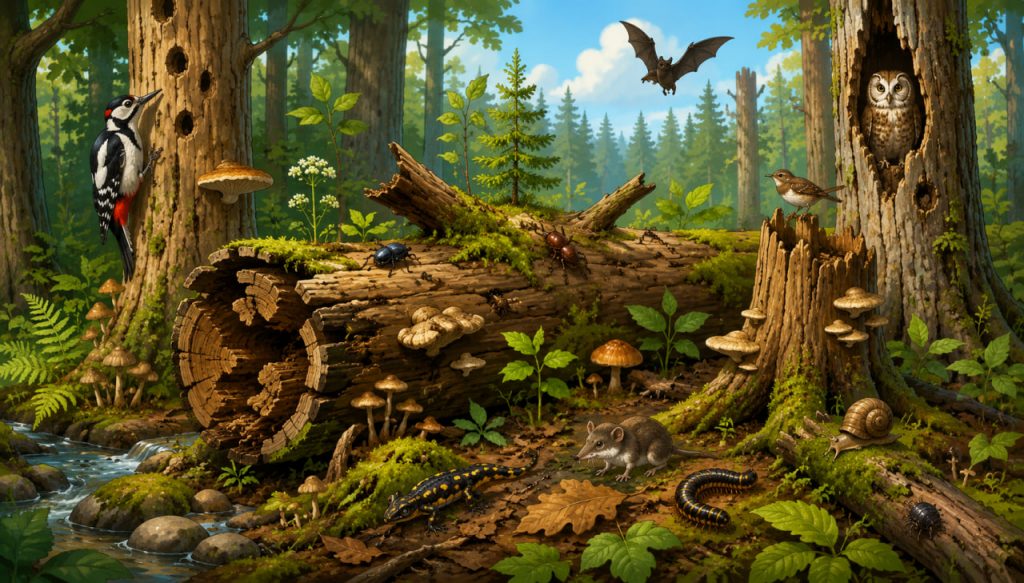
Although dead wood may appear lifeless, it quickly becomes home to a vast community of organisms.
Death Creates New Life
When a tree dies, its ecological role does not end.
Instead, the tree becomes:
- Food
- Shelter
- Habitat
- Nutrient source
for countless organisms.
Within months, fungi, insects, bacteria, and mosses begin colonizing the wood.
Over time, the dead tree transforms into an entire miniature ecosystem.
Nature’s Recycling System
Forests continuously recycle nutrients.
Living trees absorb:
- Nitrogen
- Phosphorus
- Potassium
- Carbon
from soil and air.
When trees die, these nutrients become trapped within their wood.
Without decomposition, forests would eventually run out of available nutrients.
Dead wood acts as a reservoir that slowly releases nutrients back into the ecosystem.
The Crucial Role of Fungi
Among the most important decomposers are:
- Fungi
Many fungi specialize in breaking down:
- Cellulose
- Lignin
the tough structural materials that make wood strong.
Without fungi, forests would become filled with undecomposed plant material.
Some scientists estimate that fungi are among the most important nutrient recyclers on Earth.
Insects and the Wood Economy
Dead wood supports enormous numbers of insects.
Examples include:
- Beetles
- Ants
- Termites
- Wood-boring larvae
These insects:
- Consume wood
- Tunnel through trunks
- Create habitats for other species
Many birds depend on these insects as a food source.
As a result, dead wood indirectly supports entire food webs.
Dead Trees as Wildlife Homes
Standing dead trees, often called:
- Snags
provide nesting sites for many animals.
Species that frequently use snags include:
- Woodpeckers
- Owls
- Bats
- Squirrels
- Small mammals
Many cavity-nesting birds depend almost entirely on dead trees for reproduction.
Removing all dead wood from forests can significantly reduce biodiversity.
The Nursery Logs of the Forest
In many forests, fallen logs become:
- Nurse logs
These decaying trunks provide ideal conditions for young plants.
Nurse logs retain:
- Moisture
- Nutrients
- Organic matter
Seedlings often grow more successfully on nurse logs than on surrounding soil.
In some old-growth forests, entire rows of young trees may originate from a single decomposing trunk.
Dead Wood and Carbon Storage
Dead wood plays an important role in:
- Carbon cycling
Living trees store large amounts of carbon.
When a tree dies, decomposition gradually releases some of this carbon back into the environment.
However, dead wood often stores carbon for:
- Decades
- Centuries
depending on climate and decomposition rates.
This makes forest ecosystems important components of the global carbon balance.
Forest Resilience and Recovery
Forests experience natural disturbances such as:
- Storms
- Fires
- Insect outbreaks
- Disease
These events often create large quantities of dead wood.
Rather than signaling ecosystem collapse, dead wood frequently supports recovery.
The resulting habitat diversity helps forests:
- Regenerate
- Adapt
- Recover
over time.
Why Old-Growth Forests Are Special
Old-growth forests often contain abundant dead wood.
These forests include:
- Fallen logs
- Ancient stumps
- Standing snags
- Multiple stages of decomposition
This structural diversity creates habitats for thousands of species.
Many rare organisms depend specifically on dead wood found only in mature forests.
Human Misunderstanding of Dead Wood
Historically, forest management often focused on removing dead trees.
Dead wood was viewed as:
- Waste
- Fire hazard
- Unproductive material
Modern ecological research has changed this perspective.
Scientists now understand that excessive removal of dead wood can reduce:
- Biodiversity
- Soil health
- Ecosystem stability
Many forest management programs now intentionally leave dead wood in place.
Dead Wood in Aquatic Ecosystems
Fallen trees also benefit rivers and streams.
Large woody debris can:
- Slow water flow
- Create pools
- Stabilize stream banks
- Provide habitat for fish
These structures increase habitat complexity and improve ecological conditions for aquatic organisms.
Biodiversity Hotspots
Researchers estimate that a significant percentage of forest species depend on dead wood during some part of their life cycle.
These include:
- Insects
- Birds
- Amphibians
- Reptiles
- Fungi
- Microorganisms
In many ecosystems, dead wood functions as a biodiversity hotspot.
Expert Opinion on Dead Wood Ecology
Forest ecologist Jerry Franklin has emphasized the ecological importance of dead wood in forest ecosystems.
His pioneering research demonstrated that fallen logs and standing dead trees are not waste products but critical components of healthy forests that support biodiversity, nutrient cycling, and ecosystem resilience.
Why Death Is Essential for Forest Life
The cycle of dead wood reveals one of nature’s most profound truths:
Life and death are inseparable parts of the same ecological process.
A dead tree continues serving the forest for decades after its life ends.
It becomes:
- Habitat
- Food source
- Carbon reservoir
- Seedbed
- Nutrient recycler
Without dead wood, forests would lose much of their biological richness and regenerative capacity.
Rather than representing decay alone, dead wood symbolizes renewal.
Every fallen tree contributes to the next generation of forest life, demonstrating that in nature, death is often the beginning of something new.
Interesting Facts
- Some fungi can decompose wood for more than 100 years after a tree dies.
- Many woodpecker species rely on dead trees for nesting.
- Nurse logs can support entire communities of seedlings.
- Dead wood stores carbon for decades or even centuries.
- Thousands of forest species depend on dead wood habitats.
Glossary
- Dead Wood — Non-living woody material found in forests.
- Coarse Woody Debris (CWD) — Large fallen logs, branches, and woody remains.
- Snag — A standing dead tree.
- Nurse Log — A decaying log that supports the growth of new plants.
- Decomposition — The breakdown of organic material by organisms such as fungi and bacteria.