Many people imagine evolution as a process that happened only in the distant past, producing dinosaurs, mammoths, and eventually modern humans. In reality, evolution has never stopped. It continues every day in forests, cities, oceans, farms, and even hospitals around the world.
Evolution occurs whenever:
- Genetic variation exists
- Traits are inherited
- Natural selection favors some individuals over others
Because environmental conditions are constantly changing, species continue adapting to new challenges.
Today, scientists can observe evolution directly, sometimes over just a few decades. Advances in genetics have made it possible to track evolutionary changes with unprecedented precision.
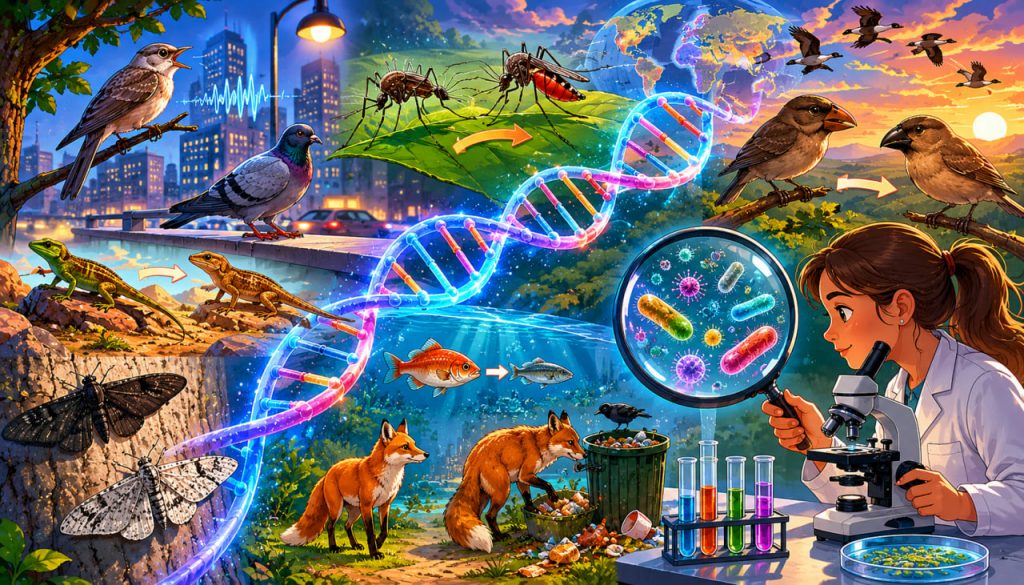
From bacteria developing resistance to antibiotics to urban animals adapting to city life, evolution is unfolding all around us.
What Does Evolution Mean?
Evolution refers to changes in the genetic characteristics of populations over generations.
Contrary to popular belief, evolution does not necessarily produce entirely new species immediately.
Often, it involves gradual changes in:
- Behavior
- Physiology
- Appearance
- Reproduction
- Survival strategies
When these changes accumulate over long periods, new species may eventually emerge.
Why Evolution Can Happen Quickly
Natural selection can act surprisingly fast.
When strong environmental pressures exist, beneficial traits may spread rapidly through populations.
Examples of strong pressures include:
- Predators
- Climate change
- Disease
- Pollution
- Human activity
Species with short generation times often evolve especially quickly because many generations occur within a few years.
Antibiotic-Resistant Bacteria
Perhaps the most famous modern example is:
- Antibiotic resistance
Bacteria reproduce extremely rapidly.
When antibiotics kill susceptible bacteria, resistant individuals survive and reproduce.
Over time, resistant strains become more common.
This process has produced bacteria capable of surviving drugs that were once highly effective.
Scientists can observe this evolutionary change in real time.
Mosquitoes and Insecticides
Mosquitoes have evolved resistance to many insecticides used for pest control.
Initially, chemical treatments may kill most mosquitoes.
However, individuals carrying resistance genes survive and pass those genes to future generations.
As a result:
- Entire populations can become resistant
within relatively short periods.
This is evolution occurring on a human timescale.
The Famous Peppered Moth
One of the best-known examples of evolution involves the:
Peppered moth
During the Industrial Revolution in Britain, pollution darkened tree bark.
Darker moths became better camouflaged against predators.
As a result:
- Dark-colored moths increased in frequency
When pollution later decreased, lighter-colored moths became common again.
This remains one of the clearest demonstrations of natural selection.
Fish Adapting to Human Harvesting
Human fishing practices can influence evolution.
In heavily fished populations, larger fish are often removed first.
This can favor fish that:
- Mature earlier
- Reproduce at smaller sizes
Researchers have documented such changes in several commercial fish species.
Human activities are therefore becoming important evolutionary forces.
Lizards Adapting to New Habitats
Scientists have observed rapid evolution in various lizard populations.
When some lizards colonize new islands or environments, changes can occur in:
- Limb length
- Body shape
- Feeding behavior
within only a few decades.
These adaptations help them exploit new ecological opportunities.
Urban Evolution
Cities create entirely new environments.
Urban animals face:
- Artificial lighting
- Noise pollution
- Traffic
- Different food sources
- New predators
Many species are evolving in response.
Examples include:
- Birds changing song frequencies
- Insects adapting to warmer city temperatures
- Mammals altering behavior around humans
Cities have become laboratories of modern evolution.
The London Underground Mosquito
One particularly fascinating example involves mosquitoes living in:
London Underground
Mosquito populations inhabiting underground tunnels became genetically distinct from their surface relatives.
They differ in:
- Behavior
- Reproduction
- Host preferences
Some scientists consider them an example of evolution potentially leading toward speciation.
Climate Change and Evolution
Climate change is creating powerful selection pressures worldwide.
Many species must adapt to:
- Rising temperatures
- Changing seasons
- Altered habitats
Researchers have documented evolutionary shifts in:
- Migration timing
- Breeding schedules
- Body size
- Heat tolerance
Some species appear capable of adapting, while others struggle.
Humans Are Still Evolving Too
Contrary to a common misconception:
Human evolution has not stopped.
Modern humans continue experiencing evolutionary changes.
Examples include:
- Lactose tolerance in certain populations
- Adaptations to high-altitude environments
- Disease resistance genes
Human culture influences evolution, but it does not eliminate it.
Darwin’s Finches Continue to Evolve
The famous finches of the:
Galápagos Islands
remain a powerful example of ongoing evolution.
Researchers have observed changes in:
- Beak size
- Beak shape
in response to environmental conditions such as droughts and food availability.
These changes can occur within a few generations.
Evolution in Action Through Genetics
Modern DNA technology allows scientists to track evolution directly.
Researchers can now:
- Compare genomes
- Identify adaptive mutations
- Measure genetic change
This has transformed evolution from a historical inference into an observable process.
Scientists can literally watch genes spread through populations.
Human Influence on Evolution
Humans have become one of the strongest evolutionary forces on Earth.
Activities affecting evolution include:
- Agriculture
- Urbanization
- Pollution
- Hunting
- Fishing
- Climate change
Many species are adapting specifically to human-created environments.
Some biologists refer to this as:
- Anthropogenic evolution
or human-driven evolution.
Expert Opinion on Modern Evolution
Evolutionary biologist Richard Lenski has conducted one of the longest-running evolution experiments in history.
His research on bacterial populations has directly demonstrated how evolution can be observed in real time, revealing the emergence of new traits and adaptations over tens of thousands of generations.
His work provides some of the strongest modern evidence that evolution remains an active and ongoing process.
Why Evolution Never Stops
Evolution is not an event from the distant past.
It is a continuous process driven by:
- Mutation
- Natural selection
- Environmental change
As long as life exists and environments change, evolution will continue.
Today, scientists can observe species adapting to:
- Cities
- Climate change
- Antibiotics
- Pollution
- Human activity
The natural world remains dynamic and constantly changing.
Every generation introduces new genetic possibilities, and natural selection continues shaping life on Earth.
In many ways, we are living during one of the most fascinating periods in evolutionary history—an era in which evolution is occurring fast enough for humans to witness it directly.
Interesting Facts
- Some bacteria can evolve noticeable changes within days.
- Urban birds often sing at higher frequencies to overcome traffic noise.
- Mosquito populations have evolved resistance to multiple insecticides.
- Human populations continue evolving adaptations to diet and environment.
- Darwin’s finches still show measurable evolutionary changes today.
Glossary
- Evolution — Change in inherited characteristics of populations over generations.
- Natural Selection — Process in which advantageous traits become more common.
- Mutation — Change in DNA that introduces genetic variation.
- Speciation — Formation of new species.
- Antibiotic Resistance — Ability of bacteria to survive antibiotic treatment.