Nature is filled with extraordinary survival strategies, but few are as fascinating as camouflage and mimicry. Across forests, oceans, deserts, and grasslands, countless animals have evolved remarkable ways to avoid detection or deceive other organisms.
Some insects look exactly like:
- Leaves
- Twigs
- Bark
Others imitate:
- Flowers
- Dangerous animals
- Even bird droppings
These adaptations allow animals to:
- Avoid predators
- Ambush prey
- Increase reproductive success
- Survive in competitive environments
Camouflage and mimicry are among the most impressive examples of evolution by natural selection. They demonstrate how millions of years of adaptation can transform an organism into what appears to be a completely different object.
In some cases, the deception is so convincing that even trained biologists struggle to spot the animal.
What Is Camouflage?
Camouflage is an adaptation that helps an organism blend into its surroundings.
The goal is simple:
Avoid being noticed.
Camouflage can involve:
- Coloration
- Patterns
- Body shape
- Behavior
Many animals use camouflage to hide from:
- Predators
- Competitors
- Prey
A perfectly camouflaged animal may be nearly invisible even when viewed from a short distance.
What Is Mimicry?
Mimicry goes a step further.
Instead of merely blending in, an organism resembles:
- Another species
- An object
- Part of its environment
The purpose is often to deceive other organisms.
For example:
- Harmless animals may imitate dangerous species.
- Predators may imitate harmless objects.
- Prey may imitate leaves or sticks.
Mimicry is essentially a biological form of impersonation.
The Leaf Insects: Masters of Disguise
Among the most famous examples are:
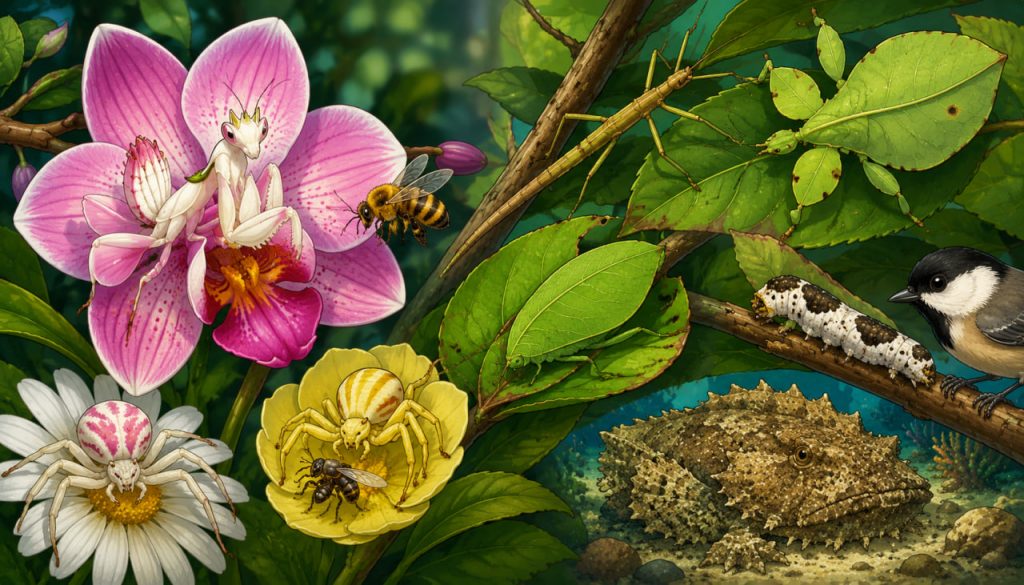
Leaf insect
These insects resemble leaves so accurately that they display:
- Leaf-like veins
- Irregular edges
- Spots resembling decay
Some even sway gently while standing still, mimicking leaves moving in the wind.
This deception helps protect them from birds and other predators.
Stick Insects and Invisible Bodies
Another remarkable example involves:
Stick insect
These insects resemble:
- Twigs
- Small branches
Their long, narrow bodies make them extremely difficult to detect among vegetation.
Many remain motionless for hours, relying entirely on their disguise.
When Predators Look Like Flowers
Camouflage is not only used by prey.
Some predators hide by pretending to be attractive plants.
A famous example is the:
Orchid mantis
This remarkable insect resembles:
- Flower petals
- Orchids
Pollinating insects approach expecting nectar and instead become prey.
The mantis effectively turns a flower into a hunting trap.
Ambush Hunters and Background Matching
Many predators rely on:
- Background matching
to remain hidden.
Examples include:
- Crocodiles
- Octopuses
- Certain spiders
These animals blend into their surroundings and wait patiently for prey to approach.
Successful camouflage often determines whether the predator eats or goes hungry.
The Incredible Camouflage of Octopuses
Few animals rival:
Mimic octopus
in camouflage ability.
Octopuses can rapidly change:
- Color
- Texture
- Body shape
using specialized skin cells.
Some species can imitate:
- Sea snakes
- Lionfish
- Flatfish
This flexibility makes them among the most sophisticated camouflage experts on Earth.
Batesian Mimicry: Pretending to Be Dangerous
One important type of mimicry is:
- Batesian mimicry
In this strategy:
- Harmless species imitate harmful species.
For example:
- Certain harmless snakes resemble venomous snakes.
- Some flies imitate stinging bees or wasps.
Predators learn to avoid the dangerous species and consequently avoid the harmless imitator as well.
Müllerian Mimicry: Sharing the Same Warning
Another strategy is:
- Müllerian mimicry
In this case:
- Multiple dangerous species evolve similar appearances.
Because predators learn faster when different harmful species share the same warning signals, all participants benefit.
This pattern is common among:
- Butterflies
- Bees
- Wasps
Bird Dropping Mimics
Some caterpillars and spiders employ an unusual disguise.
They resemble:
- Bird droppings
Although this may sound unpleasant, it is highly effective.
Most predators ignore bird droppings entirely, allowing the disguised animal to remain unnoticed.
Nature often favors practicality over elegance.
Camouflage Underwater
Marine environments contain extraordinary examples of camouflage.
Animals such as:
- Seahorses
- Stonefish
- Flounders
blend almost perfectly with:
- Coral
- Sand
- Seaweed
The stonefish is particularly impressive because it resembles a rock while possessing venomous spines.
The Evolution of Deception
Camouflage and mimicry emerge through:
- Natural selection
Individuals that are slightly better hidden are more likely to:
- Survive
- Reproduce
Over millions of years, these small advantages accumulate.
The result can be astonishingly precise imitation.
Some leaf insects appear more leaf-like than many actual leaves.
The Arms Race Between Predator and Prey
Camouflage creates an evolutionary competition.
Predators evolve:
- Better eyesight
- Better detection skills
Prey evolve:
- Better disguises
- More convincing mimicry
This continuous struggle is often called:
- An evolutionary arms race
It drives some of nature’s most spectacular adaptations.
Why Humans Struggle to Spot Camouflaged Animals
The human brain excels at recognizing patterns.
However, many camouflaged animals exploit weaknesses in visual perception.
They use:
- Disruptive coloration
- False edges
- Shape distortion
to confuse observers.
As a result, an animal may be directly visible yet remain unnoticed.
Expert Opinion on Camouflage
Evolutionary biologist Hugh Cott was one of the pioneers in the scientific study of camouflage.
His work demonstrated how coloration, pattern disruption, and environmental matching help animals avoid detection and survive in complex ecosystems.
Many modern studies of camouflage continue building upon his foundational research.
Why Camouflage and Mimicry Matter
Camouflage and mimicry reveal the extraordinary creativity of evolution.
They allow animals to:
- Hide
- Hunt
- Survive
- Reproduce
using deception rather than strength.
Whether it is a predator disguised as a flower or a prey animal disguised as a leaf, these adaptations demonstrate that survival in nature often depends not on power, but on perception.
The next time you walk through a forest or observe a garden, remember:
Some of the most fascinating creatures may be right in front of you—perfectly hidden in plain sight.
Interesting Facts
- Orchid mantises can attract pollinating insects by resembling flowers.
- Leaf insects often possess fake leaf veins and damage patterns.
- Mimic octopuses can imitate multiple marine animals.
- Some caterpillars resemble bird droppings to avoid predators.
- Stonefish are among the best-camouflaged animals in the ocean.
Glossary
- Camouflage — Adaptation that helps an organism blend into its surroundings.
- Mimicry — Adaptation in which an organism imitates another organism or object.
- Batesian Mimicry — Harmless species imitating dangerous species.
- Müllerian Mimicry — Multiple dangerous species sharing similar warning appearances.
- Natural Selection — Evolutionary process favoring traits that improve survival and reproduction.