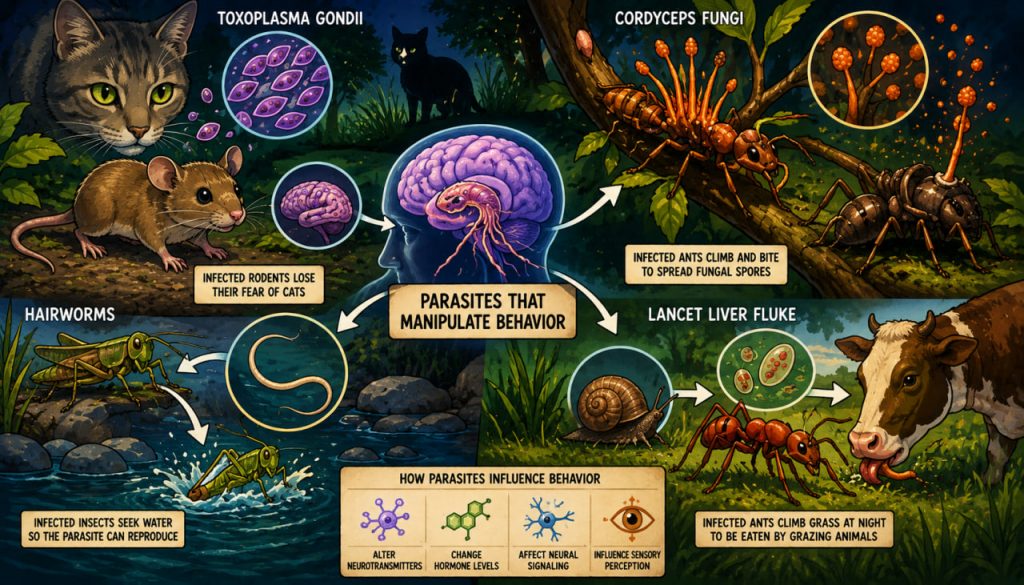
Nature is filled with extraordinary survival strategies, but few are as astonishing as parasites that manipulate the behavior of their hosts. These organisms do not merely live inside another creature—they can alter its actions in ways that improve the parasite’s chances of survival and reproduction.
Some parasites influence:
- Movement
- Fear responses
- Social behavior
- Reproduction
- Decision-making
In certain cases, infected animals behave so differently that they appear to have lost control of their own actions.
Among the most famous examples are:
- Toxoplasma gondii
- Cordyceps fungi
- Hairworms
- Lancet liver flukes
These remarkable organisms demonstrate how evolution can produce biological strategies that seem almost like science fiction.
What Is Behavioral Manipulation?
Behavioral manipulation occurs when a parasite changes the behavior of its host in a way that benefits the parasite.
The host may:
- Take greater risks
- Move to specific locations
- Interact differently with predators
- Alter normal habits
These changes are not intentional on the host’s part.
Instead, they result from biological influences on:
- The nervous system
- Hormones
- Brain chemistry
- Cellular processes
The ultimate goal is usually to help the parasite:
- Reproduce
- Spread
- Reach its next host
Why Would Evolution Favor Mind Control?
Parasites face a major challenge.
Many species require multiple hosts to complete their life cycles.
For example:
- One animal may serve as an intermediate host.
- Another may serve as the final host.
If the parasite can increase the likelihood of moving between hosts, its chances of survival improve dramatically.
Natural selection therefore favors traits that enhance transmission.
Over millions of years, this has produced some astonishing forms of biological manipulation.
Toxoplasma Gondii: The Parasite That Changes Fear
One of the most studied behavioral parasites is:
Toxoplasma gondii
This microscopic organism can infect many warm-blooded animals.
However, its primary host is:
- Cats
The parasite reproduces sexually only inside feline intestines.
To reach cats, Toxoplasma often infects rodents first.
How Toxoplasma Affects Rodents
Normally, mice and rats instinctively fear cats.
Research has shown that infected rodents may lose part of this fear response.
Some studies suggest they become:
- Less cautious
- More exploratory
- Less likely to avoid cat odors
This increases the probability of being eaten by a cat.
If that happens, the parasite successfully reaches its preferred host.
It is one of the most famous examples of behavioral manipulation in nature.
Can Toxoplasma Affect Humans?
Humans can also become infected with Toxoplasma.
Most infections cause few or no symptoms in healthy individuals.
Scientists have investigated possible links between infection and:
- Risk-taking behavior
- Personality traits
- Neurological changes
Research remains ongoing, and many questions remain unresolved.
Importantly, there is currently no evidence that Toxoplasma controls humans in the dramatic way it influences rodents.
Cordyceps: The Zombie Fungus
Few parasites are as famous as:
Cordyceps
Certain Cordyceps species infect insects, especially ants.
After entering the host, the fungus gradually spreads throughout its body.
Eventually, infected ants display unusual behavior.
The “Zombie Ant” Phenomenon
One well-studied species causes infected ants to:
- Leave their colony
- Climb vegetation
- Bite firmly onto leaves or stems
After the ant dies, the fungus grows from its body and releases spores.
The elevated position helps spread those spores to new hosts below.
Although often called “mind control,” the exact mechanisms are still being investigated.
The fungus appears to influence behavior without completely taking over the brain itself.
Hairworms and Suicidal Crickets
Another remarkable example involves:
Horsehair worm
Hairworms develop inside insects such as:
- Crickets
- Grasshoppers
As adults, the worms must return to water to reproduce.
The problem is that their hosts are terrestrial.
Researchers have observed infected insects behaving unusually, often moving toward water.
Some eventually jump into ponds or streams, where the worm emerges.
This allows the parasite to complete its life cycle.
The Lancet Liver Fluke
One of the strangest examples involves:
Lancet liver fluke
This parasite uses:
- Snails
- Ants
- Grazing mammals
during different stages of its life cycle.
When inside an ant, the parasite can influence behavior in a remarkable way.
During cool evenings, infected ants climb vegetation and clamp onto grass blades.
This increases the chance that grazing animals will consume them.
Once inside the grazing animal, the parasite reaches its final host.
Parasites and Brain Chemistry
How do parasites manipulate behavior?
Scientists have identified several possible mechanisms:
- Altering neurotransmitters
- Modifying hormone levels
- Affecting neural signaling
- Influencing sensory perception
In many cases, the exact biological pathways remain unknown.
Behavioral manipulation is an active area of research in neuroscience and evolutionary biology.
Is It Really Mind Control?
Popular media often describes these phenomena as:
- Mind control
However, scientists generally use more precise language.
Most parasites do not completely control every action.
Instead, they modify specific behaviors that improve transmission.
The result may look like mind control, but it is usually a targeted biological influence.
Why Scientists Study These Parasites
Behavior-manipulating parasites provide valuable insights into:
- Evolution
- Neuroscience
- Animal behavior
- Host-parasite interactions
By understanding how parasites alter behavior, researchers can learn more about how nervous systems function.
These studies may even contribute to future medical discoveries.
Expert Opinion on Behavioral Parasites
Evolutionary biologist David Hughes has conducted extensive research on parasitic fungi and host manipulation.
His work on zombie-ant fungi has helped reveal the remarkable complexity of parasite-host interactions and demonstrated how evolution can shape behavior in highly specialized ways.
The Evolutionary Arms Race
Hosts are not defenseless.
Over time, animals evolve:
- Immune defenses
- Behavioral resistance
- Physiological adaptations
Parasites respond with new strategies.
This creates an ongoing evolutionary arms race that has continued for millions of years.
The result is some of the most fascinating biological interactions found in nature.
Why Parasite Manipulation Matters
Parasites that alter behavior reveal an important lesson:
Behavior is ultimately rooted in biology.
By influencing biological systems, parasites can reshape actions in ways that improve their own survival.
Although these examples may seem bizarre, they demonstrate the extraordinary power of natural selection.
From mice losing fear of cats to ants transformed into fungal spore dispensers, behavioral parasites show that nature’s creativity often exceeds human imagination.
Their stories remind us that evolution does not simply produce stronger or faster organisms—it can also produce astonishing strategies that influence how other creatures think, move, and behave.
Interesting Facts
- Toxoplasma can infect nearly all warm-blooded animals.
- Some Cordyceps fungi specialize in specific insect species.
- Hairworms may grow longer than the insects they infect.
- Lancet liver flukes use three different hosts during their life cycle.
- Scientists continue discovering new examples of parasite-induced behavioral changes.
Glossary
- Parasite — Organism that lives on or inside another organism and benefits at its expense.
- Host — Organism that supports a parasite.
- Neurotransmitter — Chemical messenger used by nerve cells.
- Cordyceps — Group of parasitic fungi known for manipulating insect behavior.
- Behavioral Manipulation — Alteration of host behavior by a parasite to improve its own survival or reproduction.