When most people think of plants, they imagine peaceful forests, colorful flowers, and life-giving greenery. Plants are often viewed as passive organisms that simply grow, photosynthesize, and provide food and oxygen. However, nature has a darker side.
Some plants have evolved remarkable strategies that allow them to:
- Steal nutrients from other plants
- Drain resources from hosts
- Smother competitors
- Dominate entire ecosystems
These species are often called vampire plants and strangler plants because of the dramatic ways they survive.
Although they may sound like creatures from a horror story, these plants are real and represent some of the most fascinating examples of evolutionary adaptation in the botanical world.
What Are Vampire Plants?
Vampire plants are parasitic plants that obtain water, nutrients, and sometimes sugars directly from other plants.
Unlike most plants, many parasitic species perform little or no photosynthesis.
Instead, they connect themselves to host plants using specialized structures called:
- Haustoria
These structures penetrate the host’s tissues and tap into its internal transport systems.
In effect, the parasite turns another plant into a living source of food.
How Plant Parasitism Works
Plants transport nutrients through tissues known as:
- Xylem
- Phloem
Parasitic plants insert haustoria into these tissues.
Once connected, they can extract:
- Water
- Minerals
- Sugars
- Organic compounds
The host often continues living, but its growth and health may suffer significantly.
In severe infestations, the host plant may eventually die.
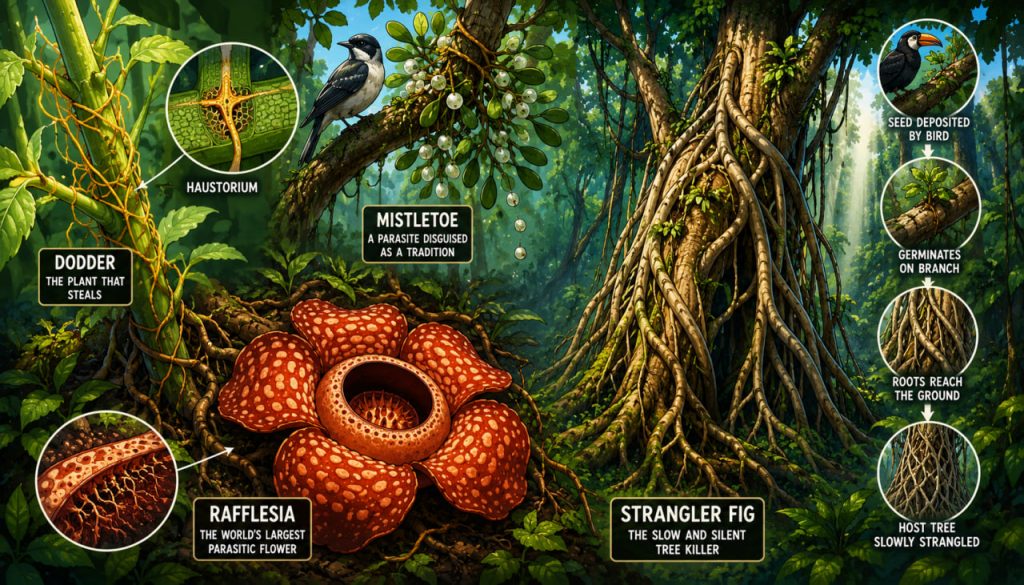
Dodder: The Plant That Looks Like Spaghetti
One of the most famous parasitic plants is:
Dodder
Dodder appears as thin yellow or orange strands wrapped around other plants.
Remarkably, mature dodder plants often have:
- No functional roots
- Very little chlorophyll
After finding a host, the plant abandons independent growth and becomes entirely dependent on its victim.
Researchers have discovered that dodder can even detect chemical signals released by potential hosts.
Mistletoe: A Holiday Parasite
Many people associate:
Mistletoe
with holiday decorations.
However, mistletoe is actually a parasitic plant.
It grows on:
- Trees
- Shrubs
and extracts water and nutrients from its host.
Although mistletoe can still perform photosynthesis, it relies heavily on host plants for survival.
Large infestations can weaken trees and make them more vulnerable to disease.
The Giant Rafflesia
One of the most extraordinary parasites is:
Rafflesia arnoldii
This species produces the largest individual flower on Earth.
Its flowers may exceed:
- One meter in diameter
Rafflesia lacks:
- Leaves
- Stems
- Roots
for most of its life cycle.
Instead, it lives almost entirely inside the tissues of host vines.
When it blooms, it emits a strong odor resembling decaying flesh, attracting pollinating insects.
What Are Strangler Plants?
Strangler plants use a different strategy.
Rather than feeding directly on hosts, they physically overwhelm them.
The most famous examples are:
Strangler fig
found in tropical forests worldwide.
How Strangler Figs Begin Life
Strangler figs often start as seeds deposited high in tree branches by birds.
The seed germinates above the ground and initially lives as an:
- Epiphyte
meaning it grows on another plant without immediately harming it.
Over time, roots descend toward the forest floor.
Once these roots reach the soil, the fig gains access to substantial resources.
Slowly Encircling the Host
As the fig grows, its roots thicken and spread around the host tree.
Eventually, they form a lattice-like network.
This network:
- Restricts growth
- Blocks sunlight
- Competes for water
- Competes for nutrients
Over decades, the host tree may weaken and die.
The fig remains standing, sometimes leaving a hollow column where the original tree once existed.
Why Evolution Produced These Strategies
Parasitism and strangulation provide important advantages.
In dense forests, competition for:
- Light
- Water
- Nutrients
can be intense.
By exploiting other plants, parasites and stranglers avoid some of the challenges faced by ordinary plants.
These strategies evolved because they improve survival and reproductive success.
Ecological Importance of Vampire Plants
Although they may seem harmful, parasitic plants often play valuable ecological roles.
They can:
- Increase biodiversity
- Regulate dominant species
- Influence ecosystem structure
Some studies suggest that parasitic plants help maintain ecological balance by preventing certain species from becoming overly dominant.
Strangler Figs as Wildlife Resources
Strangler figs are especially important in tropical ecosystems.
Their fruits feed:
- Birds
- Monkeys
- Bats
- Numerous mammals
Many rainforest animals depend on fig trees during seasons when other food sources are scarce.
Thus, a plant that kills one tree may support hundreds of animals.
Plant Communication and Detection
Recent research has revealed that some parasitic plants can detect:
- Chemical signals
- Volatile compounds
- Host-specific cues
This ability helps them identify suitable hosts.
Scientists continue investigating how these remarkable plants locate and exploit their targets.
The complexity of these interactions is far greater than previously imagined.
Can Vampire Plants Threaten Agriculture?
Yes.
Some parasitic species cause major agricultural losses.
Examples include:
- Dodder
- Broomrape
- Witchweed
These parasites can damage:
- Grain crops
- Vegetables
- Fruit plants
In certain regions, they represent significant economic challenges.
Expert Opinion on Plant Parasitism
Botanist Job Kuijt, one of the world’s leading experts on parasitic plants, emphasized that parasitic species are not botanical curiosities but highly specialized evolutionary successes.
His research demonstrated the extraordinary diversity and complexity of plant parasitism across ecosystems worldwide.
Why the Dark Side of Flora Fascinates Scientists
Vampire plants and strangler plants challenge the common image of plants as passive organisms.
They reveal that:
- Plants compete intensely
- Evolution produces unexpected strategies
- Ecological interactions can be surprisingly complex
Whether siphoning nutrients from a host or slowly enveloping an entire tree, these species demonstrate nature’s remarkable creativity.
The dark side of flora is not evil—it is simply another example of evolution finding innovative solutions to the challenge of survival.
Interesting Facts
- Dodder can detect chemical signals from nearby host plants.
- Rafflesia produces the largest individual flower on Earth.
- Some strangler figs take decades to completely overwhelm a host tree.
- Mistletoe is a true parasitic plant despite its festive reputation.
- Certain parasitic plants have almost completely abandoned photosynthesis.
Glossary
- Parasitic Plant — Plant that obtains resources from another living plant.
- Haustorium — Specialized structure used by parasitic plants to connect to hosts.
- Epiphyte — Plant that grows on another plant without initially drawing nutrients from it.
- Photosynthesis — Process by which plants convert sunlight into chemical energy.
- Strangler Fig — Tropical fig species that gradually surrounds and outcompetes host trees.