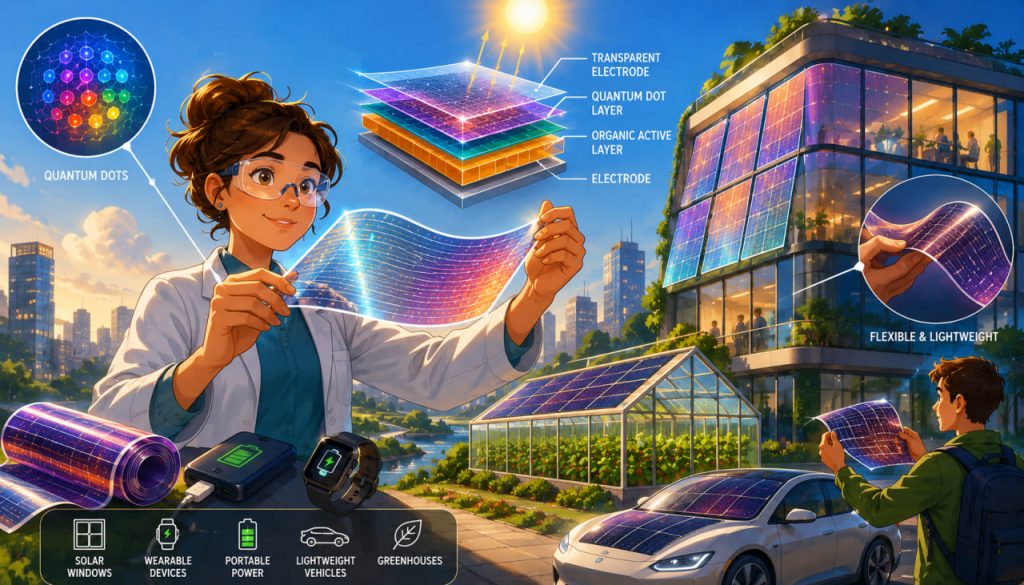
Solar energy is usually associated with rigid blue-black panels mounted on rooftops or arranged in large solar farms. These silicon panels dominate today’s market because they are efficient, durable, and increasingly affordable. But the future of solar technology may include a very different class of materials: quantum dots and organic solar cells.
These next-generation photovoltaic technologies are exciting because they can be lightweight, flexible, semi-transparent, printable, and adaptable to surfaces where ordinary solar panels are difficult to install. Imagine solar windows, curved solar roofs, energy-generating greenhouses, solar films on vehicles, wearable electronics, or building facades that quietly produce electricity.
They are not yet ready to replace conventional silicon panels everywhere. Their main challenges are long-term stability, efficiency, scaling, cost, and real-world durability. But they open a wider vision of solar power: not only panels on roofs, but solar materials integrated into everyday objects and buildings.
What Are Quantum Dot Solar Cells?
Quantum dots are extremely tiny semiconductor particles, usually only a few nanometers wide. At this scale, materials behave differently because of quantum effects.
One of the most important features of quantum dots is that their optical properties can be tuned by changing their size and composition. Smaller or larger dots can absorb and emit different wavelengths of light.
This makes quantum dots interesting for solar energy because they may help capture parts of the solar spectrum that ordinary materials do not use efficiently.
Quantum dots can be used in several ways:
- As the light-absorbing layer in quantum dot solar cells
- As luminescent particles in solar concentrators
- As coatings that improve existing solar panels
- As materials for semi-transparent photovoltaic glass
- As spectral converters for greenhouses and building windows
Quantum dots are like nanoscale light managers: they can absorb, convert, and redirect sunlight.
What Are Organic Solar Cells?
Organic solar cells use carbon-based molecules or polymers to convert sunlight into electricity.
Unlike silicon cells, which are made from inorganic crystalline material, organic photovoltaics can be produced from solution-based inks and thin films. This gives them unique design advantages.
Organic solar cells can be:
- Lightweight
- Flexible
- Semi-transparent
- Printable
- Color-tunable
- Suitable for curved surfaces
- Potentially cheaper in large-scale roll-to-roll manufacturing
They are especially promising for applications where low weight and flexibility matter more than maximum efficiency.
For example, an organic solar film could be placed on a curved surface where a rigid silicon panel would be awkward or impossible.
Organic solar cells are less about replacing every rooftop panel and more about bringing solar power to surfaces silicon cannot easily reach.
Why Flexibility Matters
Most traditional solar panels are heavy, rigid, and covered with glass. That is excellent for durability but limiting for design.
Flexible solar cells can be installed on:
- Curved roofs
- Vehicles
- Portable chargers
- Tents
- Backpacks
- Temporary structures
- Lightweight buildings
- Greenhouses
- Wearables
- Drones
This opens markets that conventional solar panels serve poorly.
For developing regions, disaster relief, military use, remote monitoring, and mobile electronics, lightweight solar films can be valuable even if their efficiency is lower.
The best solar technology is not always the most efficient one; sometimes it is the one that can be placed where energy is needed.
Transparent and Semi-Transparent Solar Power
One of the most attractive ideas is transparent or semi-transparent solar technology.
If solar cells can let visible light pass through while harvesting part of sunlight, they could be used in windows, skylights, atriums, facades, and greenhouses.
Quantum dot luminescent solar concentrators are especially interesting for this. They can absorb certain wavelengths and guide light toward solar cells at the edges of the glass.
A 2024 research paper reported a fully assembled quantum dot luminescent solar concentrator photovoltaic glazing device designed to meet international standards for photovoltaic and building elements, while also functioning as a visible light communication receiver under full sunlight.
Semi-transparent solar cells usually produce less electricity than opaque panels. But their advantage is surface area. Cities have enormous glass facades and windows.
A solar window does not need to outperform a rooftop panel to be useful; it only needs to turn unused glass into active energy surface.
Why These Technologies Could Be Cheaper
Organic and quantum dot solar technologies are often discussed as potentially cheap because some designs can be made with solution processing.
That means materials may be deposited like inks through printing, coating, spraying, or roll-to-roll manufacturing.
This could reduce:
- Material use
- Weight
- Energy-intensive processing
- Installation complexity
- Transport costs
- Manufacturing waste
However, “potentially cheap” does not always mean cheap today. Laboratory devices can be expensive. Scaling production requires reliable materials, stable encapsulation, quality control, and long operating lifetimes.
The promise is low-cost manufacturing; the challenge is proving it at industrial scale.
Efficiency: The Hard Reality
Silicon solar panels are mature and efficient. They have decades of manufacturing experience behind them.
Organic solar cells and quantum dot solar cells are improving, but many remain below mainstream silicon in commercial performance and lifetime.
NREL’s best research-cell efficiency chart tracks confirmed records across many photovoltaic technologies, including organic cells, organic tandem cells, and quantum dot cells. It shows that these emerging technologies have made progress, but they still compete with highly mature silicon, thin-film, and tandem technologies.
For transparent solar designs, the challenge is even harder: if a window lets most visible light through, it cannot absorb that same visible light for electricity.
This creates a basic trade-off:
More transparency usually means less power. More power usually means less transparency.
Stability: The Biggest Barrier
The main reason these technologies are not everywhere yet is durability.
Solar products must survive:
- Sunlight
- Heat
- Cold
- Moisture
- Oxygen
- Wind
- Mechanical bending
- Cleaning
- UV exposure
- Years of daily cycling
Organic materials can degrade when exposed to oxygen, moisture, and ultraviolet light. Quantum dots may face issues with oxidation, surface defects, toxicity concerns depending on composition, and long-term stability.
This is why encapsulation is so important. The solar layer must be protected without destroying flexibility, transparency, or low cost.
A solar film that works beautifully in the lab must still survive real roofs, windows, rain, heat, and time.
Quantum Dots as Solar Boosters
Quantum dots may also help improve existing solar panels rather than replacing them.
For example, quantum dot coatings can be designed to convert unused wavelengths into light that solar cells can use more effectively. They can also be used in luminescent concentrators that redirect light to photovoltaic strips.
Recent commercial interest has focused on using quantum dots to boost panel performance, especially by capturing or converting light in ways that improve energy yield. Reports have described partnerships aimed at commercializing quantum dot coatings for solar panels, including safer copper-indium-based designs instead of older heavy-metal quantum dots.
This may be a more practical near-term path than building entire quantum dot solar panels from scratch.
Quantum dots may first become solar enhancers before they become mainstream solar cells.
Organic Solar Cells for Indoor and Low-Light Power
Organic photovoltaics can work well in certain low-light conditions, depending on design.
This makes them interesting for indoor electronics and Internet of Things devices.
Possible uses include:
- Smart sensors
- Indoor trackers
- Remote controls
- Wearable devices
- Smart labels
- Wireless environmental monitors
- Low-power electronics
In these cases, the goal is not to power a house. The goal is to power small devices without constantly replacing batteries.
Organic solar cells may become especially useful where small amounts of power are needed continuously.
Expert Perspective
Researchers in next-generation photovoltaics often emphasize that new solar technologies should not be judged only by peak efficiency. A flexible, transparent, lightweight solar film may be valuable even if it produces less power per square meter than silicon, because it can be used in places where silicon panels are impractical.
The U.S. National Renewable Energy Laboratory tracks emerging photovoltaic records separately because different solar technologies have different strengths, development stages, and application targets.
The expert view is clear: the future of solar energy will likely be a portfolio of technologies, not one winner for every surface and use case.
Where These Solar Cells Could Be Used First
The most realistic early markets are not necessarily ordinary rooftops.
Better early uses include:
- Solar windows
- Building facades
- Greenhouses
- Portable chargers
- Wearable electronics
- Indoor sensors
- Vehicle-integrated films
- Temporary structures
- Lightweight roofing
- Smart city devices
In these applications, flexibility, weight, color, or transparency can matter as much as efficiency.
For example, a greenhouse solar film must allow enough useful light for plants while generating electricity. A building facade must look acceptable to architects and property owners. A wearable device must bend and remain comfortable.
Next-generation solar will succeed where its special features solve problems that silicon cannot solve elegantly.
The Future of Flexible and Transparent Solar
Quantum dots and organic solar cells represent a broader shift in solar thinking.
Instead of asking only, “How do we make the most efficient panel?” researchers are asking:
- Can solar be transparent?
- Can solar be printed?
- Can solar bend?
- Can solar power sensors indoors?
- Can solar become part of windows and facades?
- Can solar materials be lighter, thinner, and more design-friendly?
These questions matter because the clean energy transition needs not only large solar farms, but also distributed energy surfaces integrated into everyday life.
The future may not be one giant solar panel. It may be millions of small, smart, flexible solar surfaces quietly working around us.
Interesting Facts
- Quantum dots are nanoscale particles whose light absorption and emission can change depending on their size.
- Organic solar cells use carbon-based molecules or polymers instead of crystalline silicon.
- Transparent solar cells face a natural trade-off between visibility and electricity generation.
- Quantum dot luminescent solar concentrators can guide light toward solar cells at the edges of glass.
- Organic photovoltaics may be useful for lightweight, flexible, portable, and indoor applications.
- NREL tracks organic and quantum dot solar cells among emerging photovoltaic technologies.
- Some quantum dot solar approaches focus on improving existing panels rather than replacing them completely.
Glossary
- Quantum Dot — A nanoscale semiconductor particle whose optical properties depend on size and composition.
- Organic Solar Cell — A photovoltaic device made from carbon-based molecules or polymers.
- Photovoltaic — A technology that converts light directly into electricity.
- Semi-Transparent Solar Cell — A solar cell that allows some visible light to pass through while generating electricity.
- Luminescent Solar Concentrator — A material that absorbs light and redirects it toward solar cells placed at its edges.
- Roll-to-Roll Manufacturing — A production method where flexible materials are processed continuously on rolls, similar to newspaper printing.
- Encapsulation — Protective sealing that shields solar materials from moisture, oxygen, and damage.
- Power Conversion Efficiency — The percentage of incoming light energy converted into usable electrical energy.