
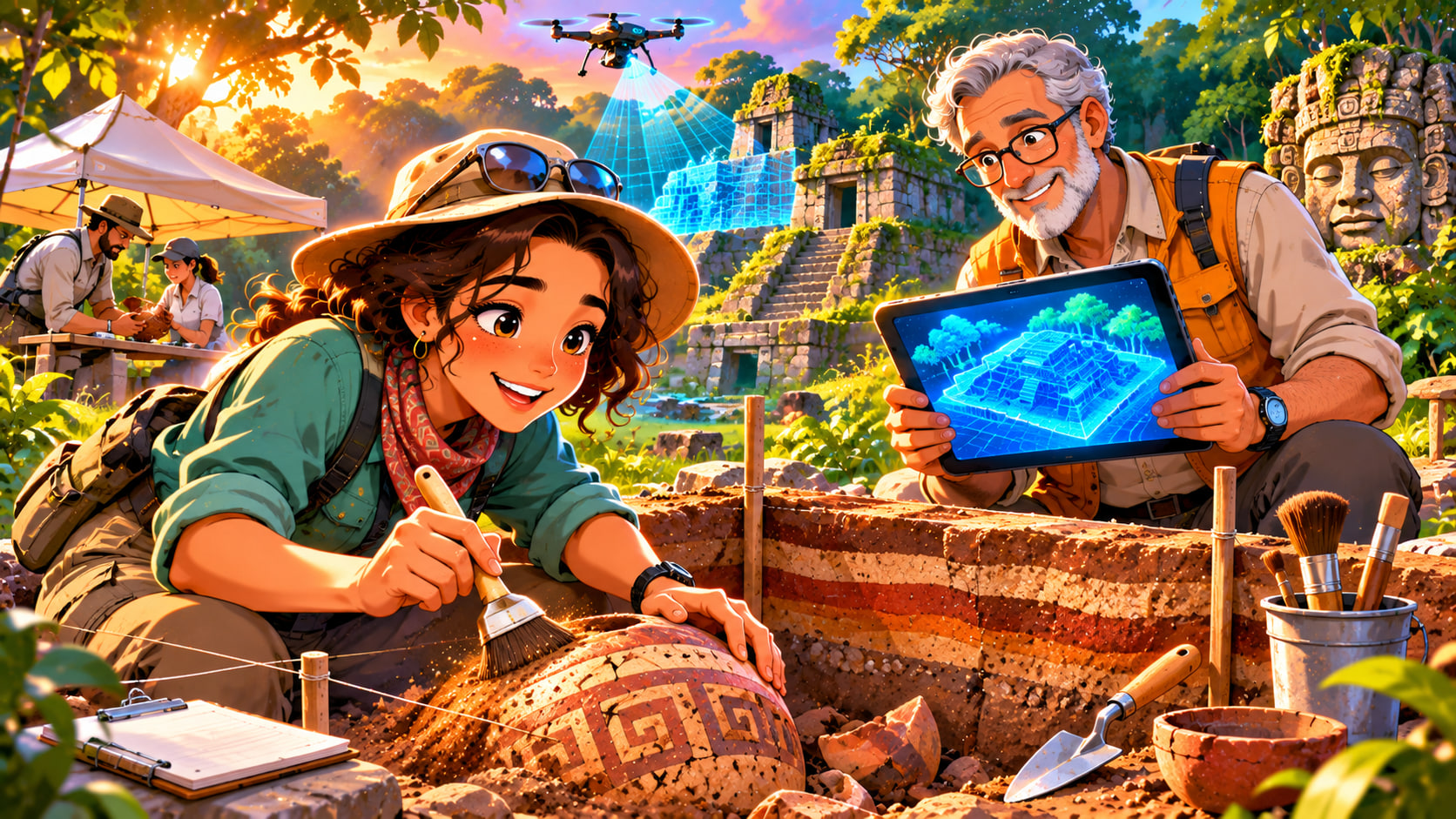
A tiny piece of pottery emerges from the soil, its surface marked by a fingerprint left thousands of years ago. Nearby, a dark patch shows where someone once lit a fire. Neither find looks like treasure, yet together they can reveal what people cooked, where they lived, and how their communities changed. Archaeology turns ordinary traces into extraordinary human stories.
From buried Roman streets to cities hidden beneath tropical forests, archaeology explores much more than pyramids and gold. Researchers combine excavation with chemistry, genetics, satellites, and digital imaging. The most important discovery is often not an object, but the information preserved around it. Understanding how archaeologists reconstruct that information reveals why the past is still full of surprises.
What Does Archaeology Actually Study?
Archaeology investigates human lives through material remains, including tools, buildings, food waste, graves, and altered landscapes. An artifact might be a stone blade, a pot, or a discarded bead. Archaeologists study how these objects relate to structures and the surrounding environment. Their questions range from what prehistoric families ate to how ancient cities organized trade and government. A broken cooking vessel can reveal more about daily life than an elaborate crown.
Why Archaeological Context Matters More Than Treasure
A coin can identify an ancient ruler, but its location may reveal much more. Was it found inside a market, beneath a collapsed house, or next to a burial? Researchers call these relationships archaeological context, and they carefully record a discovery before disturbing it. Photographs, measurements, soil descriptions, and nearby objects help establish how a find was used. Removing artifacts without documentation can permanently destroy information, even if the objects themselves survive.
How Excavations Reveal Layers of History
Settlements change as people rebuild houses, discard materials, experience floods, and repair roads. The resulting deposits form layers studied through stratigraphy. In undisturbed ground, deeper layers are usually older, although later pits and erosion can complicate the sequence. A buried floor might contain food remains and a hearth, while the layer above records a fire followed by rebuilding. Reading these relationships lets archaeologists reconstruct events that written histories never recorded.
How Can Archaeologists Tell How Old Something Is?
Radiocarbon dating measures the remaining carbon-14 in once-living materials such as charcoal, bone, and wood. It is useful for suitable samples dating back roughly 50,000 years, although results require calibration against known-age records. The technique cannot directly date an ordinary stone wall simply by testing its rock. Instead, researchers may analyze charcoal associated with its construction, along with pottery styles and geological layers. A reliable archaeological timeline often combines several independent clues.
Pompeii: A Roman City Frozen in Time
When Mount Vesuvius erupted in 79 CE, volcanic material buried Pompeii and neighboring communities. Excavations have uncovered streets, shops, houses, wall paintings, and traces of ordinary routines. Graffiti and shop equipment help researchers investigate people rarely mentioned in accounts of emperors and battles. The disaster preserved extraordinary evidence but also caused enormous human suffering. Today, conservators work to protect the exposed buildings and fragile objects from weather, tourism, and gradual deterioration.
Göbekli Tepe: Monumental Buildings Before Cities
At Göbekli Tepe in southeastern Türkiye, monumental stone structures were erected broadly between 9600 and 8200 BCE. Their towering T-shaped pillars contain carvings of animals and abstract patterns. The builders lived during a period when communities were experimenting with cultivation and increasingly settled lifestyles, making these structures remarkable evidence of early collective organization. Archaeologists continue investigating what activities occurred there and how the site was used. Sophisticated communal projects existed long before written records or the emergence of classical civilizations.
Lasers Are Revealing Lost Maya Cities and Amazonian Settlements
LiDAR uses laser pulses from aircraft to build accurate models of terrain beneath dense vegetation. In northern Guatemala, a large survey revealed more than 60,000 ancient Maya structures, including buildings, roads, terraces, and defenses. In 2024, researchers led by archaeologist Stéphen Rostain described extensive ancient settlements in Ecuador's Upano Valley, connected by roads and agricultural features. Some date back around 2,500 years. These discoveries show that seemingly untouched forests can conceal landscapes extensively transformed by earlier populations. Field visits remain essential to confirm what the laser maps reveal.
How Ancient DNA Rewrites the Human Family Tree
Bones and teeth sometimes preserve fragments of ancient DNA that survive for thousands of years. In carefully controlled laboratories, researchers analyze those fragments to investigate population movements, relationships, and interactions among human groups. Geneticist Svante Pääbo received the 2022 Nobel Prize in Physiology or Medicine for pioneering discoveries about extinct human relatives. His work helped establish interbreeding between modern humans and Neanderthals and contributed to identifying Denisovans. DNA cannot reveal a person's complete life story, so genetic findings are interpreted alongside archaeological evidence.
Exploring Shipwrecks and Cities Beneath the Water
Maritime archaeology investigates shipwrecks, ports, and submerged settlements using divers, sonar, and underwater robots. A ship's cargo can reveal trading connections, food preferences, and technologies that linked distant communities. Waterlogged environments sometimes preserve wood and other materials that would quickly decay on land. Yet recovery is difficult because materials can deteriorate when exposed to air. Researchers often document wrecks in place instead of removing artifacts, protecting both their physical condition and historical context.
Why Protecting Archaeological Sites Matters
Archaeological sites face threats from construction, looting, armed conflict, erosion, and changing environmental conditions. Once an object is removed without documentation, its connections to surrounding evidence may be lost forever. Ethical research increasingly involves local and descendant communities in decisions about excavations, collections, and human remains. Digital records, conservation, and public education help safeguard discoveries for future generations. If you could join an excavation tomorrow, would you choose a buried ancient city, an underwater shipwreck, or a settlement hidden beneath the rainforest? Share your answer in the comments.
Interesting Facts
- Charred seeds and animal bones can reveal what people ate thousands of years ago.
- Radiocarbon dating commonly investigates suitable organic remains up to about 50,000 years old.
- Vesuvius buried Pompeii during an eruption in 79 CE, preserving remarkable evidence of Roman life.
- Göbekli Tepe's monumental structures were built thousands of years before the Egyptian pyramids.
- A LiDAR survey in Guatemala documented more than 60,000 ancient Maya structures.
- Research published in 2024 identified extensive ancient settlements and roads in Ecuador's Amazonian Upano Valley.
- Ancient DNA has revealed genetic connections between modern humans and Neanderthals.
Glossary
- Archaeology — The study of past human activity through physical remains and their contexts.
- Artifact — An object made, modified, or used by people.
- Archaeological Context — The original location and associations that give a discovery meaning.
- Stratigraphy — The study of layers to reconstruct the sequence of past events.
- Radiocarbon Dating — A method of estimating the age of organic material using carbon-14.
- Göbekli Tepe — An early Neolithic archaeological site in Türkiye with monumental carved stone pillars.
- LiDAR — Laser-based technology used to measure distances and map terrain.
- Ancient DNA — Genetic material recovered from organisms that lived in the past.
- Maritime Archaeology — The study of human activity associated with waterways and submerged sites.