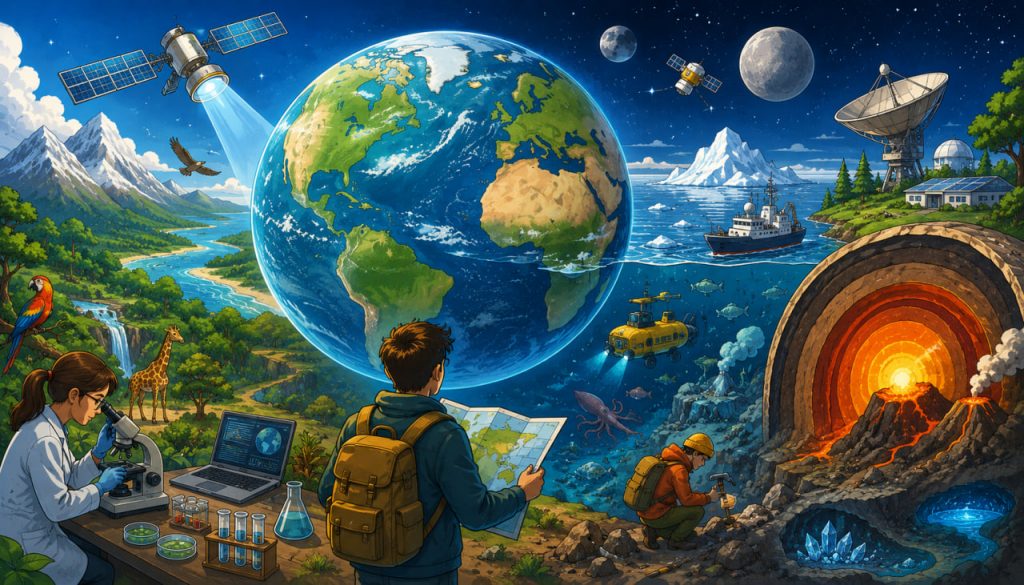
Humanity has explored space, landed probes on distant planets, mapped galaxies billions of light-years away, and built machines capable of analyzing the smallest particles in existence. Yet despite these incredible achievements, scientists still admit that Earth itself remains deeply mysterious in many ways.
Large parts of our planet remain unexplored, poorly understood, or only partially studied. From the deepest oceans to underground ecosystems and complex climate systems, Earth still hides countless secrets.
Modern science has revealed an enormous amount about the planet — but compared to the complexity of Earth’s systems, humanity may still be only at the beginning of understanding the world we live on.
Earth: A Complex Living System
Earth is not simply a rock floating in space. It is an interconnected system involving:
- Atmosphere
- Oceans
- Geological activity
- Climate cycles
- Ecosystems
- Microbial life
Each system constantly interacts with the others.
Even small changes in one area can influence global conditions in unexpected ways.
This complexity makes Earth incredibly difficult to fully understand.
How Much of the Ocean Have We Explored?
One of the most surprising facts about Earth is how little humans have explored the deep ocean.
Scientists estimate that a large percentage of the ocean floor remains poorly mapped or completely unexplored.
The deep sea is difficult to study because of:
- Extreme pressure
- Darkness
- Cold temperatures
- Massive distances
Marine researcher Sylvia Earle famously said:
“We know more about the surface of the Moon than the bottom of the ocean.”
This statement highlights how many mysteries still exist beneath Earth’s oceans.
Unknown Species on Earth
Scientists discover thousands of new species every year.
Many organisms remain undiscovered in:
- Tropical rainforests
- Deep oceans
- Underground ecosystems
- Remote mountain regions
Some estimates suggest millions of species may still be unknown to science.
Microorganisms are especially mysterious because they are difficult to study and exist almost everywhere.
Even today, humanity likely shares the planet with countless life forms never scientifically documented.
The Mystery Beneath Earth’s Surface
Humans have barely penetrated Earth’s crust.
The deepest man-made hole ever drilled, the Kola Superdeep Borehole, reached only about 12 kilometers deep — a tiny fraction of Earth’s total radius.
The planet’s interior remains largely inferred through:
- Seismic waves
- Magnetic field analysis
- Geological modeling
Scientists cannot directly observe most of Earth’s internal structure.
Processes deep within the mantle and core continue shaping:
- Volcanoes
- Earthquakes
- Continental movement
- Magnetic fields
yet much remains uncertain.
Climate Systems Are Extremely Complex
Modern climate science has advanced dramatically, but Earth’s climate remains one of the most complicated systems ever studied.
Climate involves interactions between:
- Oceans
- Atmosphere
- Ice sheets
- Solar radiation
- Vegetation
- Human activity
Scientists use enormous supercomputers to simulate climate behavior, but many details remain difficult to predict precisely.
Small variables can sometimes produce large long-term effects.
Earth’s Ancient History
Geologists and paleontologists reconstructed much of Earth’s history through:
- Fossils
- Rock layers
- Chemical analysis
- Ice cores
However, huge gaps still exist.
Scientists continue debating details about:
- Early life evolution
- Ancient climate shifts
- Mass extinctions
- Continental formation
Earth’s history spans over 4.5 billion years — far beyond complete human reconstruction.
The Human Brain and Earth Research
Ironically, one limitation in understanding Earth is the human brain itself.
The planet operates on enormous scales involving:
- Millions of interacting variables
- Vast timescales
- Complex ecosystems
Humans naturally struggle to fully visualize systems of such complexity.
This is why modern science increasingly depends on:
- Artificial intelligence
- Satellite monitoring
- Big data analysis
- Supercomputer modeling
to study Earth more effectively.
Satellites Changed Planetary Understanding
Satellites revolutionized Earth science.
Modern satellites monitor:
- Weather systems
- Ocean temperatures
- Deforestation
- Pollution
- Ice sheet changes
- Atmospheric chemistry
For the first time in history, humanity can observe Earth as a dynamic global system in real time.
This dramatically improved environmental understanding.
Earth’s Biosphere Is Still Full of Surprises
Scientists increasingly realize that life on Earth is far more interconnected than previously believed.
Research continues revealing:
- Complex fungal networks
- Microbial communication systems
- Ecosystem interdependence
- Animal intelligence
The biosphere behaves more like a highly connected web than isolated individual species.
Many ecological relationships remain only partially understood.
Can Humanity Ever Fully Understand Earth?
Most scientists believe complete understanding may never be possible.
Earth is:
- Dynamic
- Evolving
- Massively complex
New discoveries constantly reshape scientific understanding.
Every major scientific advance often reveals additional unanswered questions.
In science, knowledge does not eliminate mystery — it often expands it.
Why Understanding Earth Matters
Understanding Earth is not just scientific curiosity. It directly affects:
- Climate policy
- Natural disaster prediction
- Agriculture
- Resource management
- Public health
- Biodiversity protection
As human influence on the planet increases, understanding Earth’s systems becomes increasingly important for civilization’s future.
The Future of Planetary Exploration
Future Earth science may involve:
- AI-driven environmental modeling
- Deep-ocean robotics
- Advanced satellite systems
- Genetic ecosystem analysis
- Underground exploration technologies
Humanity may learn more about Earth in the next century than in all previous history combined.
Yet the planet will likely continue surprising us.
Interesting Facts
- More than 70% of Earth’s surface is covered by oceans.
- Scientists discover thousands of new species every year.
- The deepest ocean trenches are deeper than Mount Everest is tall.
- Earth’s core remains inaccessible to direct observation.
- Satellites constantly collect enormous amounts of planetary data.
Glossary
- Biosphere — The global system containing all living organisms and ecosystems.
- Mantle — The thick layer of Earth located between the crust and the core.
- Seismic Waves — Vibrations traveling through Earth, used to study internal structure.
- Ecosystem — A community of living organisms interacting with their environment.
- Climate System — The interconnected global processes influencing Earth’s climate.