When people imagine life on Earth, they usually think of forests, oceans, grasslands, or tropical jungles. Yet some of the planet’s most remarkable organisms live in places that seem completely inhospitable. Hidden deep within rock fractures, beneath glaciers, inside Antarctic ice, and in microscopic pores of stone exists a hidden world known as cryptic biota.
The term “cryptic biota” refers to communities of organisms that live concealed within environments where life was once thought impossible. These organisms survive under conditions involving:
- Extreme cold
- Intense radiation
- Severe drought
- Nutrient scarcity
- Limited sunlight
Their existence challenges our understanding of life’s limits and provides important clues about where life might exist beyond Earth.
Scientists increasingly view cryptic ecosystems as some of the most fascinating frontiers in biology.
What Is Cryptic Biota?
The word “cryptic” comes from a Greek term meaning:
- Hidden
- Concealed
Cryptic biota includes organisms that spend most or all of their lives inside protected environments such as:
- Rock cracks
- Ice layers
- Underground pores
- Mineral cavities
- Deep subsurface habitats
These ecosystems are often invisible from the surface.
Despite their hidden nature, they can contain surprisingly complex communities.
Why Life Hides in Rocks
At first glance, rocks seem lifeless.
However, many rocks contain:
- Tiny fractures
- Microscopic pores
- Mineral cavities
These spaces provide protection from environmental extremes.
Inside rocks, organisms may be shielded from:
- Ultraviolet radiation
- Temperature fluctuations
- Desiccation
- Strong winds
For some species, rocks function as natural shelters.
Endoliths: Organisms Living Inside Stone
Among the most famous members of cryptic biota are:
- Endoliths
The term means:
- “Inside rock”
Endoliths include:
- Bacteria
- Algae
- Fungi
- Archaea
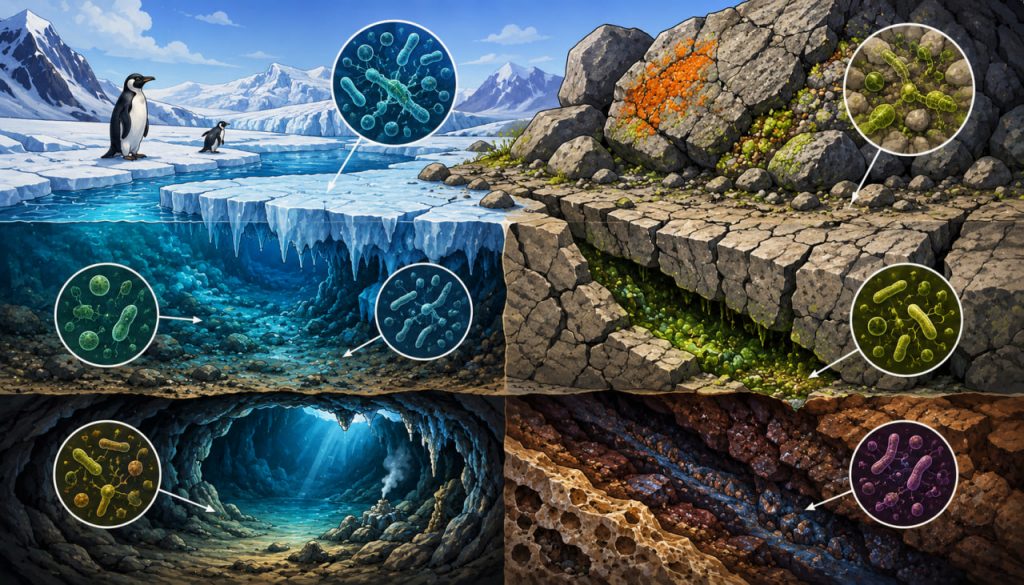
Some species live several millimeters or centimeters beneath rock surfaces.
In deserts and polar regions, endolithic communities often represent the dominant form of life.
Life Beneath Antarctic Ice
One of the most remarkable discoveries in modern biology involves microorganisms living beneath Antarctic ice sheets.
Scientists have found microbial communities surviving:
- Under glaciers
- Within ice
- Beneath permanently frozen lakes
These ecosystems may remain isolated for:
- Thousands
- Tens of thousands
- Even millions of years
Despite the darkness and cold, microbial life continues functioning.
The Dry Valleys of Antarctica
The:
McMurdo Dry Valleys
are among the harshest environments on Earth.
Conditions include:
- Extremely low temperatures
- Minimal precipitation
- Intense UV exposure
Yet researchers have discovered microorganisms living inside translucent rocks.
The rocks allow small amounts of sunlight to penetrate while providing protection from the hostile environment outside.
Life in Glacial Ecosystems
Glaciers may appear sterile, but they support surprising biological activity.
Scientists have identified:
- Bacteria
- Algae
- Microscopic fungi
living within ice.
Some organisms inhabit:
- Meltwater channels
- Ice crystals
- Subglacial lakes
These ecosystems play important roles in nutrient cycling and carbon processes.
Surviving Without Sunlight
Many cryptic organisms cannot rely entirely on photosynthesis.
Instead, some obtain energy through:
- Chemosynthesis
This process uses chemical reactions rather than sunlight.
Energy sources may include:
- Iron compounds
- Sulfur compounds
- Hydrogen
- Methane
Such strategies allow life to thrive in complete darkness.
Deep Biosphere: Life Far Below the Surface
Perhaps the largest cryptic ecosystem is the:
- Deep Biosphere
Scientists have discovered microorganisms living:
- Hundreds of meters underground
- Several kilometers beneath Earth’s surface
These organisms inhabit:
- Fractured rock
- Deep aquifers
- Ancient geological formations
Some estimates suggest that a substantial fraction of Earth’s microbial life may exist underground.
Extreme Adaptations
Cryptic organisms possess remarkable adaptations.
These include:
- Freeze-resistant proteins
- DNA repair mechanisms
- Slow metabolism
- Radiation resistance
Some microbes can remain dormant for extended periods and become active when conditions improve.
These abilities allow survival where most life forms would perish.
Why Cryptic Biota Matters
Studying cryptic ecosystems helps scientists answer fundamental questions:
- What are the limits of life?
- How does life adapt to extreme environments?
- Could life exist elsewhere in the Solar System?
These questions extend beyond biology into:
- Geology
- Planetary science
- Astrobiology
Implications for Life on Mars
Many researchers consider cryptic biota important analogs for potential extraterrestrial life.
Mars possesses:
- Cold temperatures
- High radiation
- Dry conditions
similar to some extreme Earth environments.
If life ever existed on Mars, protected habitats within rocks may have offered the best chance for survival.
Cryptic ecosystems therefore provide valuable models for future exploration.
Europa and Enceladus
Interest also extends to icy moons such as:
Europa
and
Enceladus
Both worlds appear to contain subsurface oceans beneath thick ice layers.
Scientists speculate that microbial ecosystems similar to Earth’s hidden ice communities could potentially exist there.
Although no extraterrestrial life has been discovered, cryptic biota demonstrates that life can survive under surprisingly harsh conditions.
How Scientists Study Hidden Life
Investigating cryptic ecosystems requires specialized techniques.
Researchers use:
- DNA sequencing
- Microscopy
- Ice core drilling
- Geological sampling
- Chemical analysis
These methods allow scientists to identify organisms that may be impossible to observe directly.
Modern molecular biology has greatly expanded our understanding of these hidden worlds.
Expert Opinion on Life in Extreme Environments
Astrobiologist Penelope Boston has emphasized that extreme environments on Earth provide valuable insights into where life might survive elsewhere in the universe.
Her research on subsurface ecosystems has demonstrated that life can occupy habitats once considered completely uninhabitable.
Why Hidden Life Changes Our View of Earth
The discovery of cryptic biota has transformed biology.
It shows that life does not require:
- Comfortable temperatures
- Abundant sunlight
- Rich ecosystems
Instead, life can persist in tiny fractures, beneath kilometers of ice, and deep underground.
These organisms reveal the extraordinary resilience of living systems.
The hidden ecosystems beneath our feet and under polar ice remind us that Earth still contains biological frontiers waiting to be explored.
Far from being lifeless, some of the planet’s most extreme environments host thriving communities that continue to expand our understanding of what life truly is—and where it may exist.
Interesting Facts
- Some Antarctic microbes live permanently inside rocks.
- Microbial communities have been found beneath kilometers of ice.
- The deep biosphere may contain billions of tons of living organisms.
- Certain microbes survive using chemical energy rather than sunlight.
- Cryptic ecosystems help scientists search for life beyond Earth.
Glossary
- Cryptic Biota — Hidden communities of organisms living in concealed habitats.
- Endolith — Organism that lives inside rock.
- Chemosynthesis — Production of energy from chemical reactions rather than sunlight.
- Deep Biosphere — Ecosystems located deep beneath Earth’s surface.
- Astrobiology — Scientific study of life in the universe and its potential existence beyond Earth.